Attention failure in an enterprise RAG assistant: how would you respond?
Junior scenario interview question on Attention within LLM Fundamentals.
Read full explanationA day-by-day 14-day plan before an applied LLM onsite: gap audit, project story, retrieval, evaluation, system design, coding, a full mock, then rest.
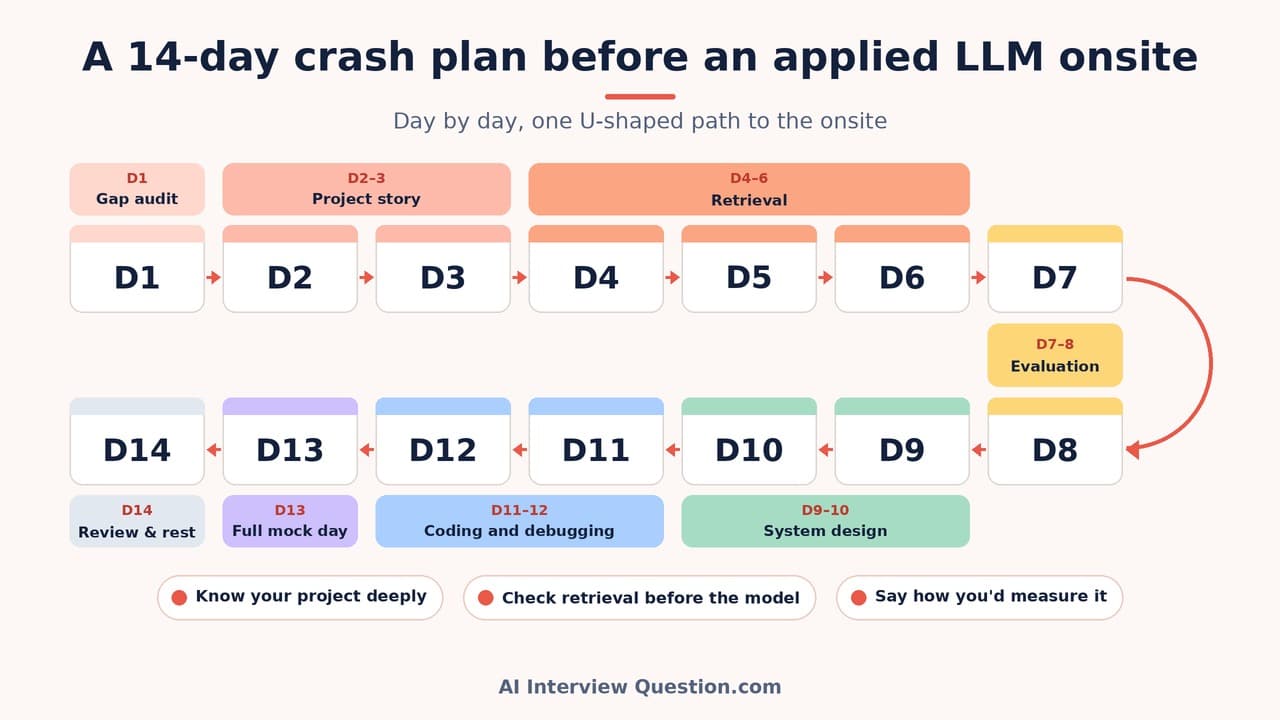
Fourteen days is not long before an applied LLM onsite, but it is enough to sharpen what you already know and close the gaps that tend to show up across a full day of interviews. This plan assumes you have built at least one project with a language model and can code comfortably. It focuses on depth in a few areas rather than skimming everything, and it saves the last days for rehearsal.
Day 1 is a gap audit. List the rounds you expect, such as coding, LLM system design, a project deep-dive, and behavioral. For each, write down the three questions you would least like to be asked. That list drives the rest of the plan.
Days 2 and 3 are your project. Pick the one project you will talk about most and rebuild your understanding of it from the ground up. Why that model, that prompt structure, that retrieval setup? What broke, how did you find out, and what did you change? Write a five-minute version and a one-minute version.
Days 4 to 6 are retrieval. Expect follow-ups on chunking, retrieval quality, reranking, and query handling. Practice checking retrieval separately from generation, and be ready to say when a reranker earns its latency. The RAG interview guide at /blog/rag-interview-guide, the chunking guide at /blog/chunking-and-overlap-rag-interview-guide, and the reranker guide at /blog/when-to-add-reranker-rag-interview are the core reading.
Days 7 and 8 are evaluation. Prepare a two-minute answer to how you would know a system is ready to ship: a fixed test set, separate checks for retrieval, faithfulness, and usefulness, and a review of failures before each change. The LLM evaluation guide at /blog/llm-evaluation-interview-guide covers how to frame it.
Days 9 and 10 are system design. Practice two or three prompts on paper with a timer: a support assistant, an internal search tool, a document workflow with tools. Use the same shape each time. Clarify requirements, sketch the data flow, go deep on retrieval, explain evaluation, draw failure paths, and close with cost and latency. The LangGraph agent system design guide at /blog/langgraph-agent-system-design-interview-guide and the LLM cost and latency guide at /blog/llm-cost-latency-interview-guide fill in the details. The composite story at /blog/failed-llm-system-design-round shows what goes wrong when you skip steps.
Days 11 and 12 are coding and debugging. Practice small, practical problems: parsing structured model output, writing a retry wrapper, batching requests, or scoring a test set. Talk while you code, because an onsite grades how you reason as well as the result.
Day 13 is a full mock day. Run your rounds back to back with breaks, the way the onsite will feel. Notice where your energy drops and where your answers get vague.
Day 14 is light review and rest. Reread your one-minute project story, your evaluation answer, and your system design shape. Prepare a few honest questions for each interviewer. Then stop studying early.
The thread through all fourteen days is the same. Know your own project deeply, check retrieval before blaming the model, show how you would measure quality, and say what you would check when you do not know an answer.
Deep explanations with architecture diagrams for every question below.
Junior scenario interview question on Attention within LLM Fundamentals.
Read full explanationJunior trade-off interview question on Batching within LLM Inference & Optimization.
Read full explanationJunior trade-off interview question on BPE within LLM Fundamentals.
Read full explanationJunior debugging interview question on Attention within LLM Fundamentals.
Read full explanationSenior debugging interview question on Autoscaling within LLM Inference & Optimization.
Read full explanationSenior debugging interview question on Decode within LLM Fundamentals.
Read full explanationStaff debugging interview question on External Knowledge within LLM Fundamentals.
Read full explanationMid-Level debugging interview question on INT4 within LLM Inference & Optimization.
Read full explanation