Featured guide
Interview Prep
A 10-day crash plan for MCP and tool-calling interviews
A day-by-day 10-day plan for MCP and tool-calling interviews: basics, a small server, tool design, failure modes, security, orchestration, and evaluation.
Interview guides
Deep study guides for production AI interviews — RAG, agents, MCP, evaluation, and system design — each paired with curated questions.
Loading guides...
Browse by topic
93 guides · 644 curated questions

Featured guide
Interview Prep
A day-by-day 10-day plan for MCP and tool-calling interviews: basics, a small server, tool design, failure modes, security, orchestration, and evaluation.
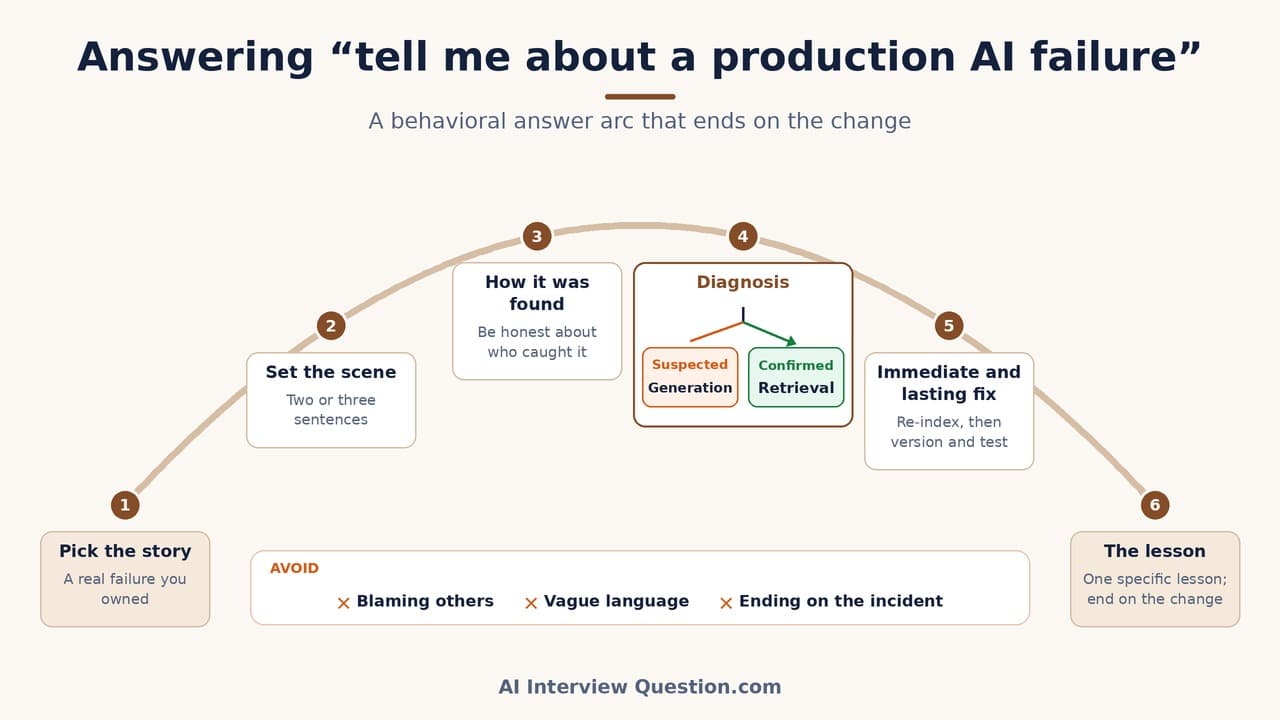
Interview PrepA composite story on answering the production AI failure question: pick the right story, diagnose honestly, show the lasting fix, and end on the change.
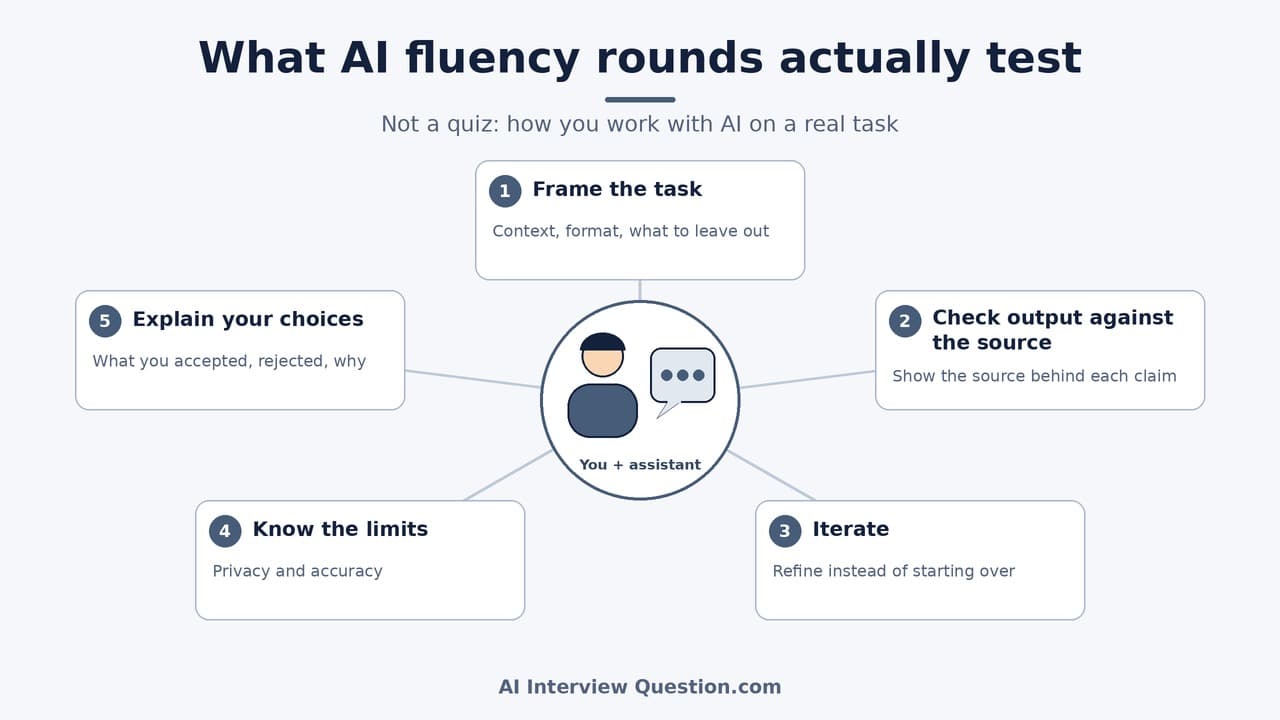
Interview PrepA composite story of an AI fluency interview: not a quiz, but framing tasks, checking output against sources, iterating, knowing limits, and explaining choices.
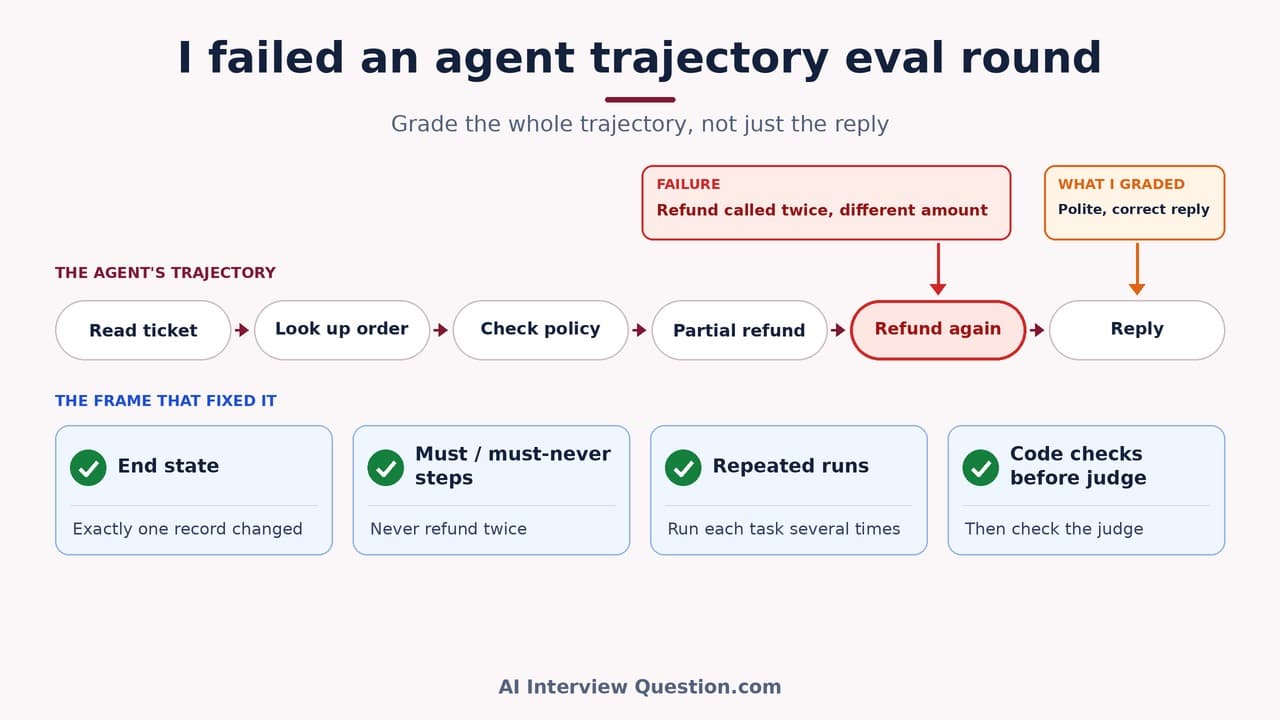
Interview PrepA composite story of a failed agent evaluation interview: grading the reply instead of the trajectory, single runs, vague judges, and the frame that fixed it.
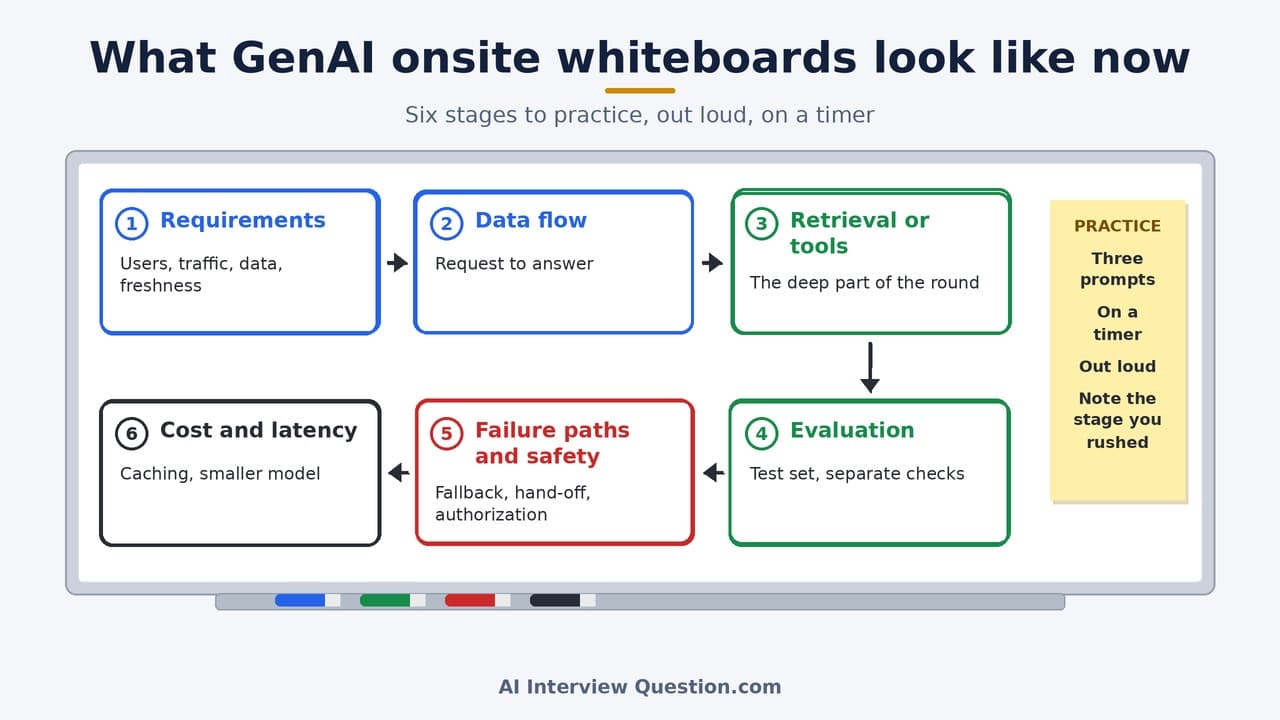
Interview PrepA common GenAI onsite whiteboard format in six stages: requirements, data flow, retrieval or tools, evaluation, failure paths, and cost, plus how to practice.
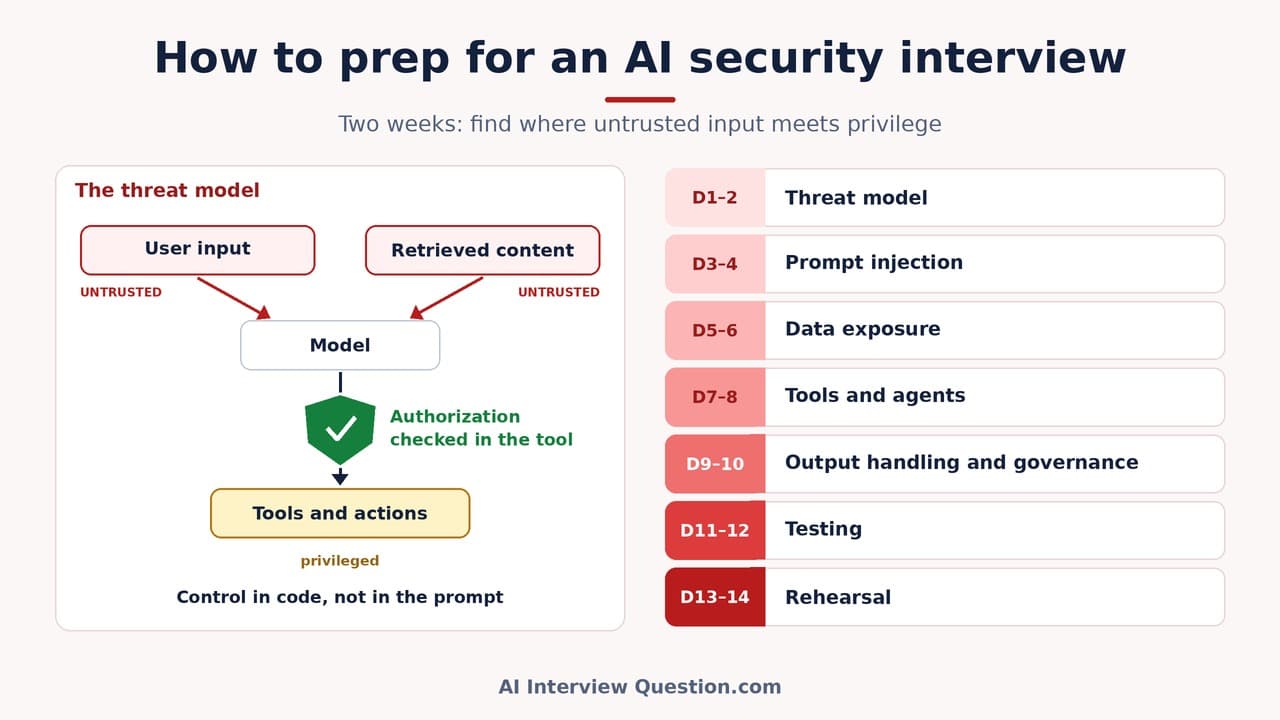
Interview PrepA two-week plan for AI security interviews: threat modeling, prompt injection, data exposure, tool permissions, governance, testing, and a rehearsal.
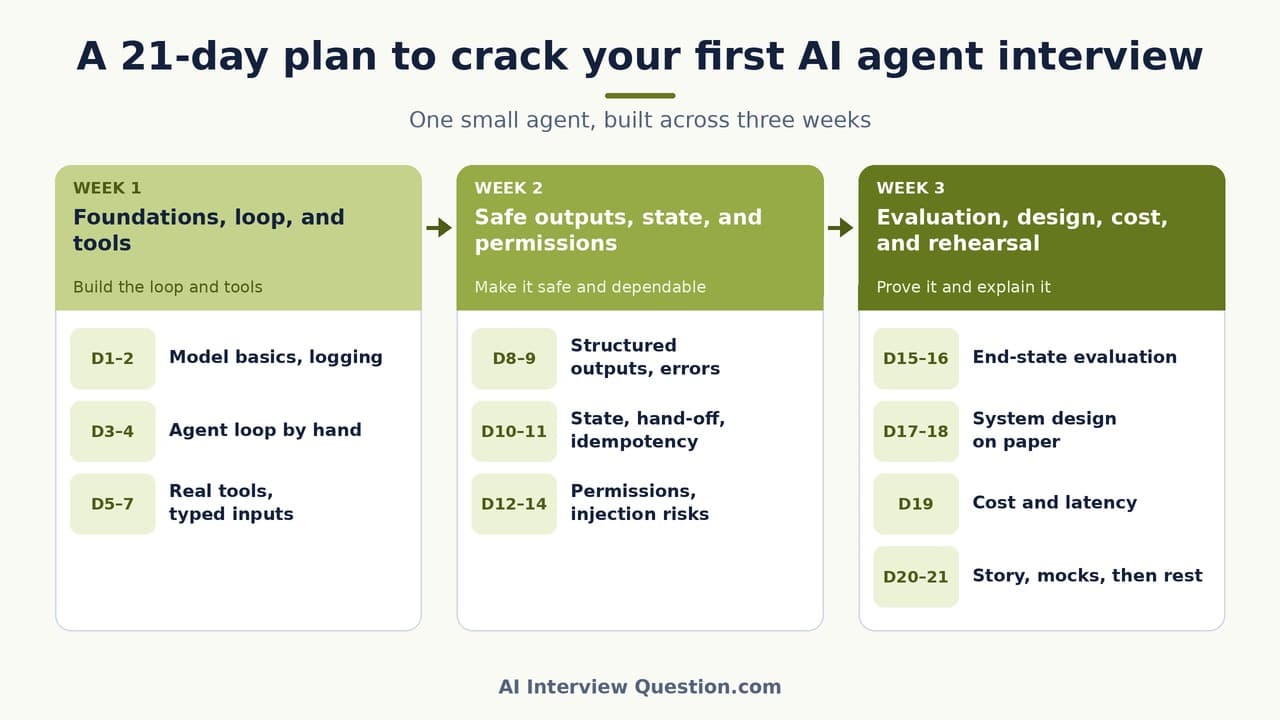
Interview PrepA three-week plan for your first AI agent interview: build the loop and tools, make them safe and dependable, then prove and explain the agent you built.
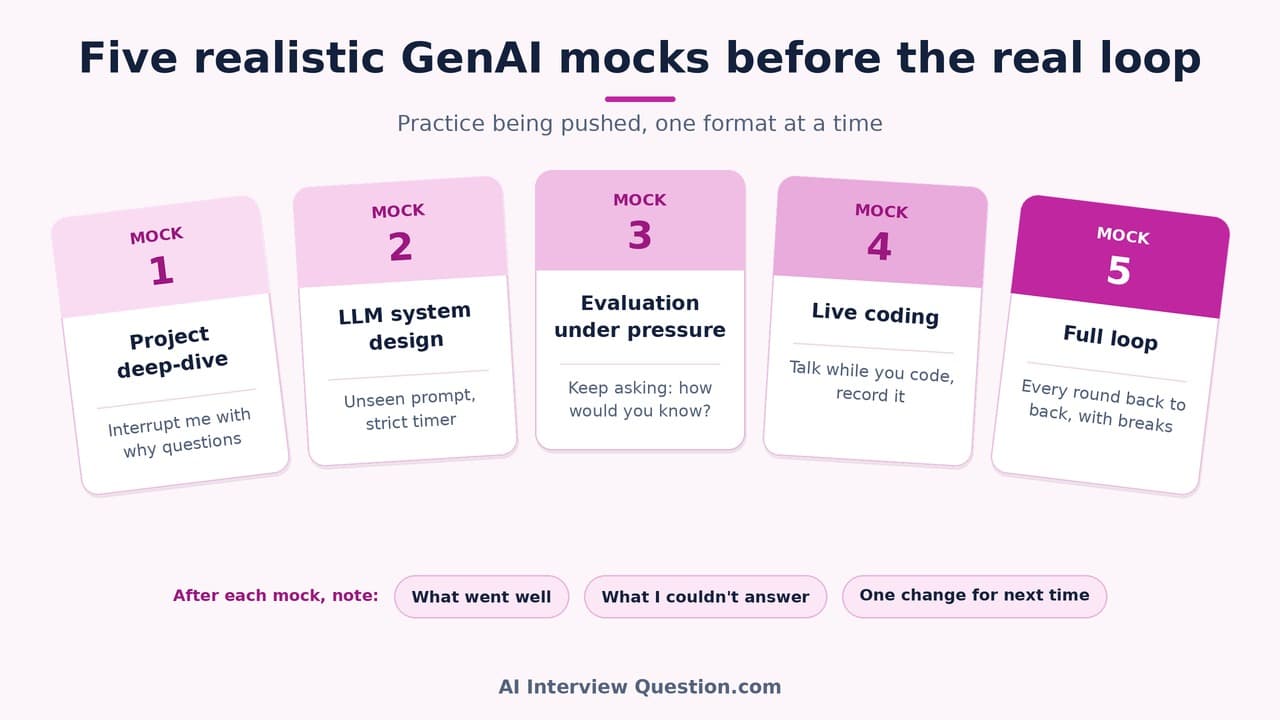
Interview PrepA composite story of five GenAI mock interviews before a real loop: project deep-dive, system design, evaluation, live coding, and a full back-to-back day.
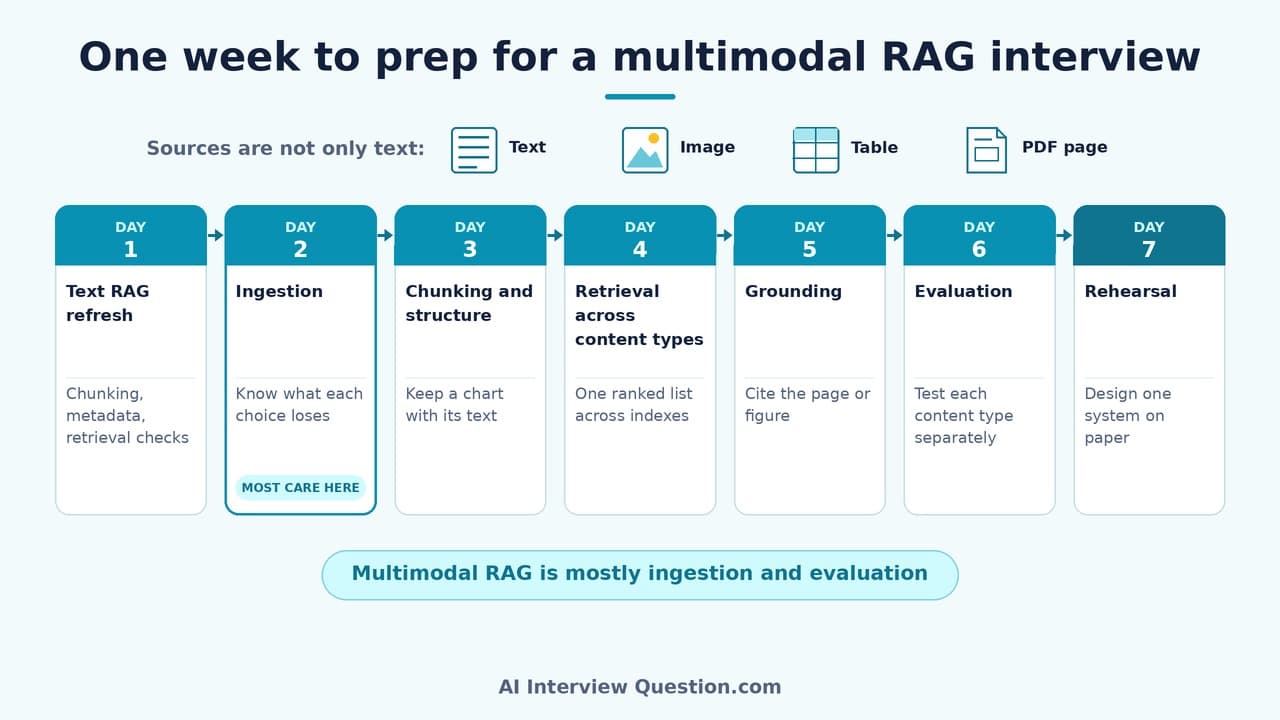
Interview PrepA seven-day plan for a multimodal RAG interview: ingestion choices, structure-aware chunking, retrieval across content types, grounding, and evaluation.
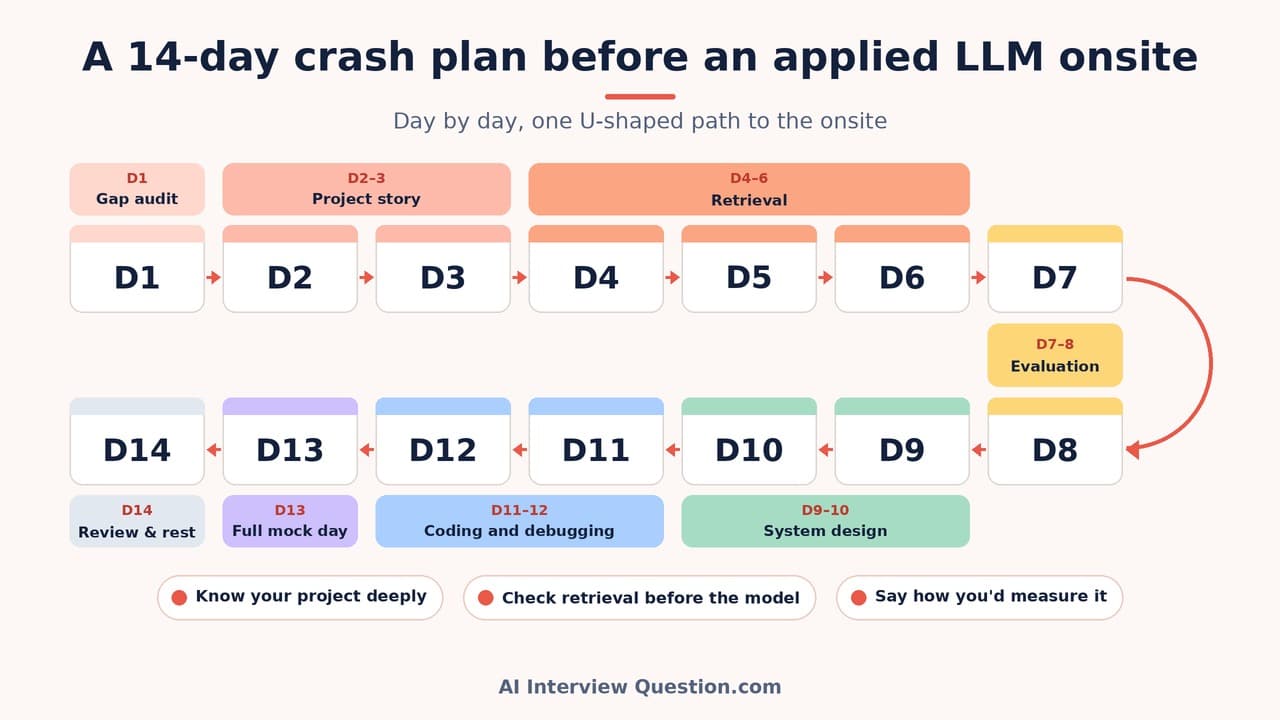
Interview PrepA day-by-day 14-day plan before an applied LLM onsite: gap audit, project story, retrieval, evaluation, system design, coding, a full mock, then rest.
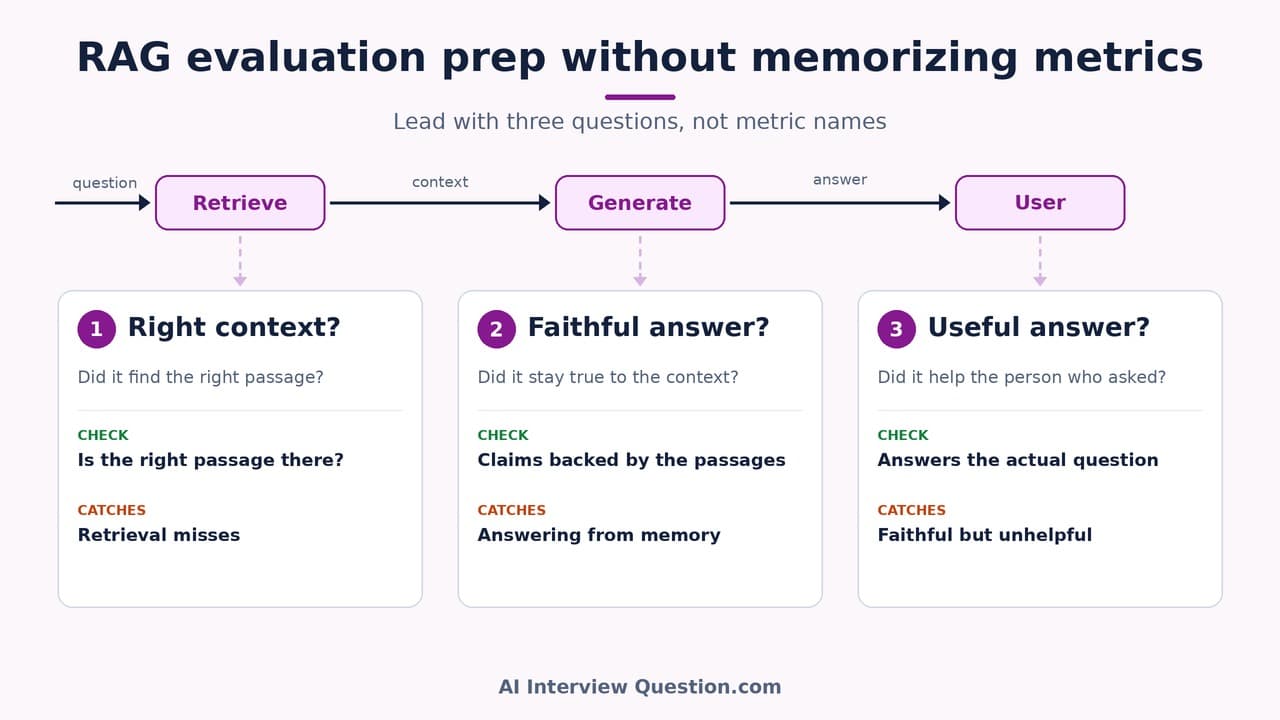
Interview PrepA composite story of preparing for RAG evaluation interviews by asking three questions: right context, faithful answer, useful answer, not metric names.
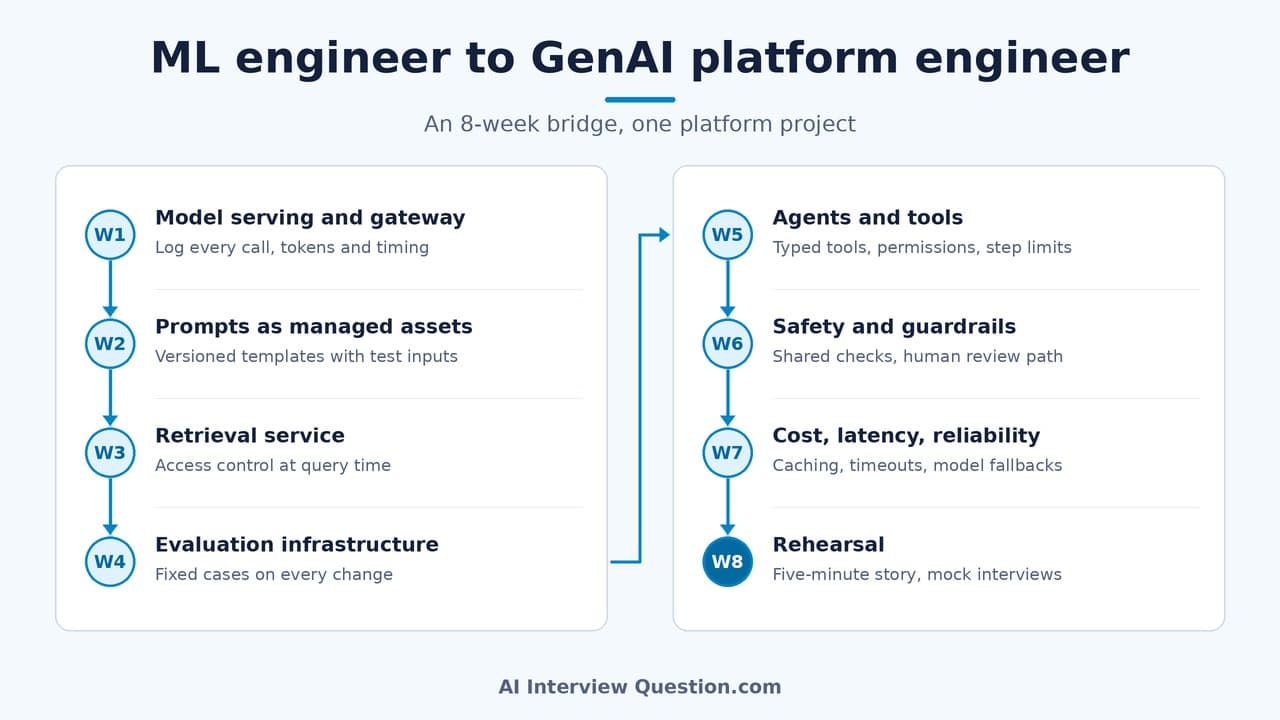
CareerAn eight-week bridge for ML engineers moving into GenAI platform work: gateways, prompts, retrieval, evaluation, tools, guardrails, cost, and rehearsal.
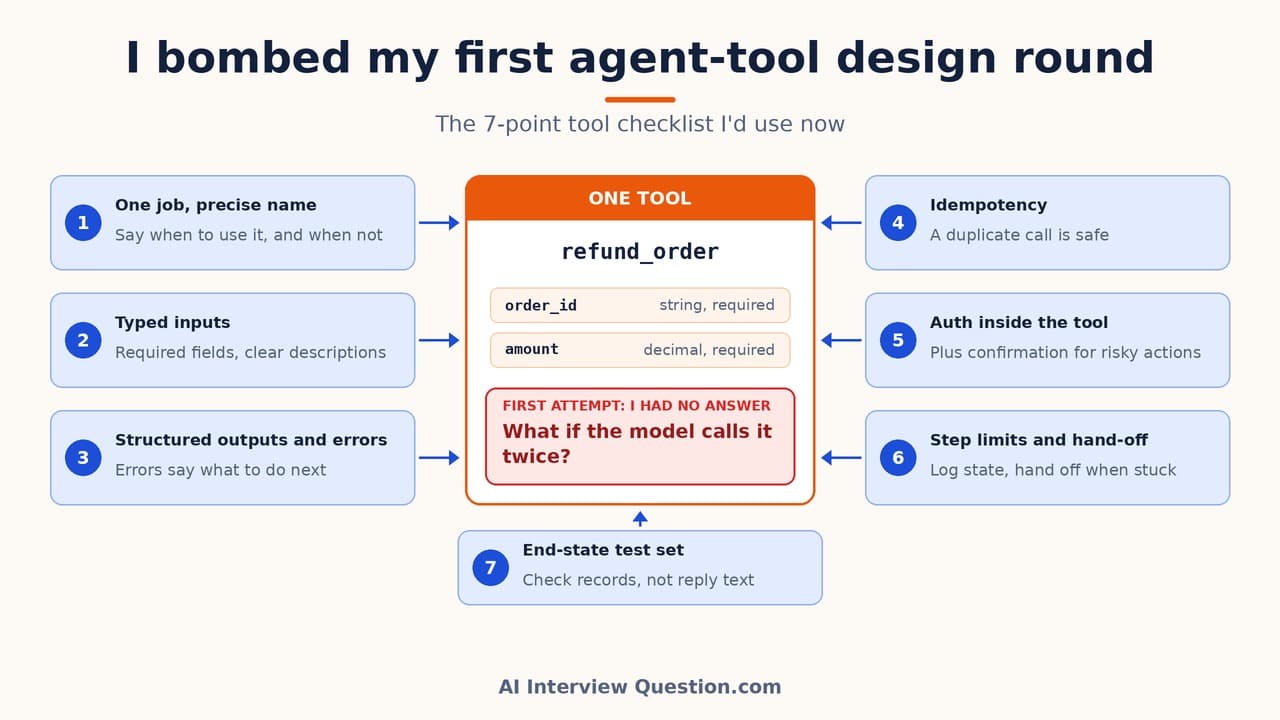
Interview PrepA composite story of a failed agent-tool design interview: six mistakes, from unsafe retries to missing permission checks, and the checklist that fixes them.
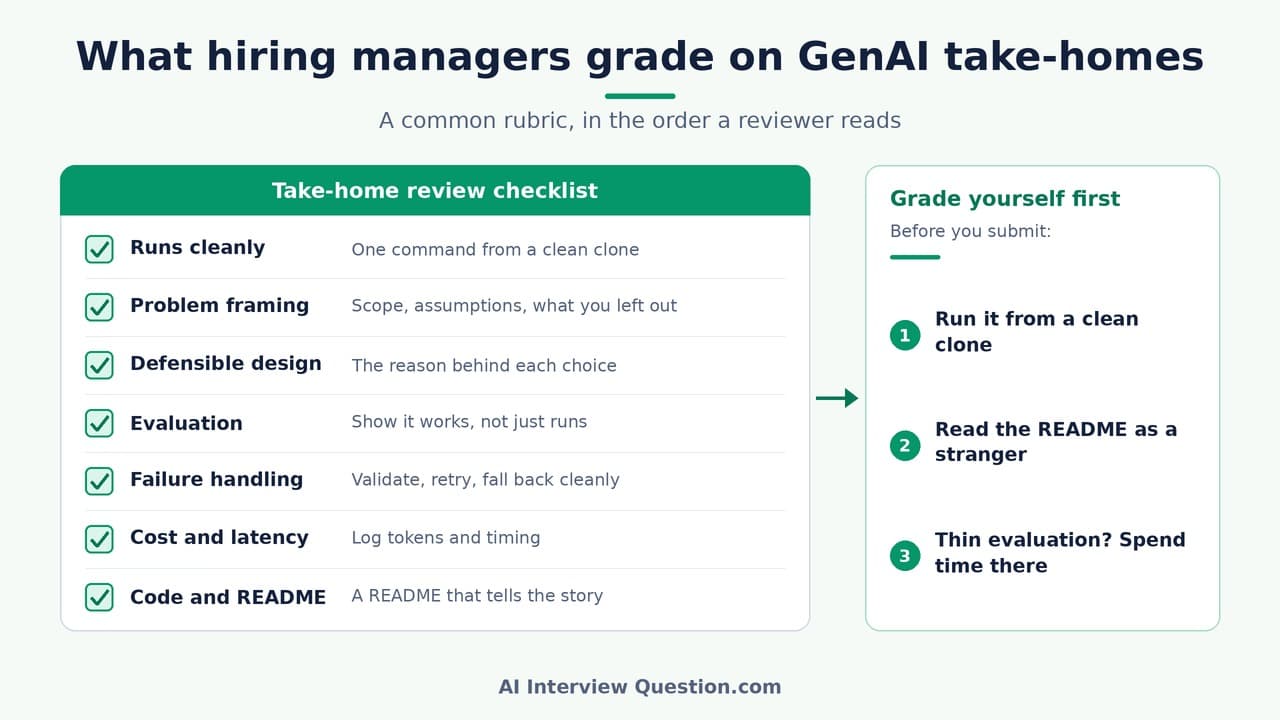
Interview PrepA common grading rubric for GenAI take-home assignments: runs cleanly, clear scope, defensible design, real evaluation, failure handling, and a strong README.
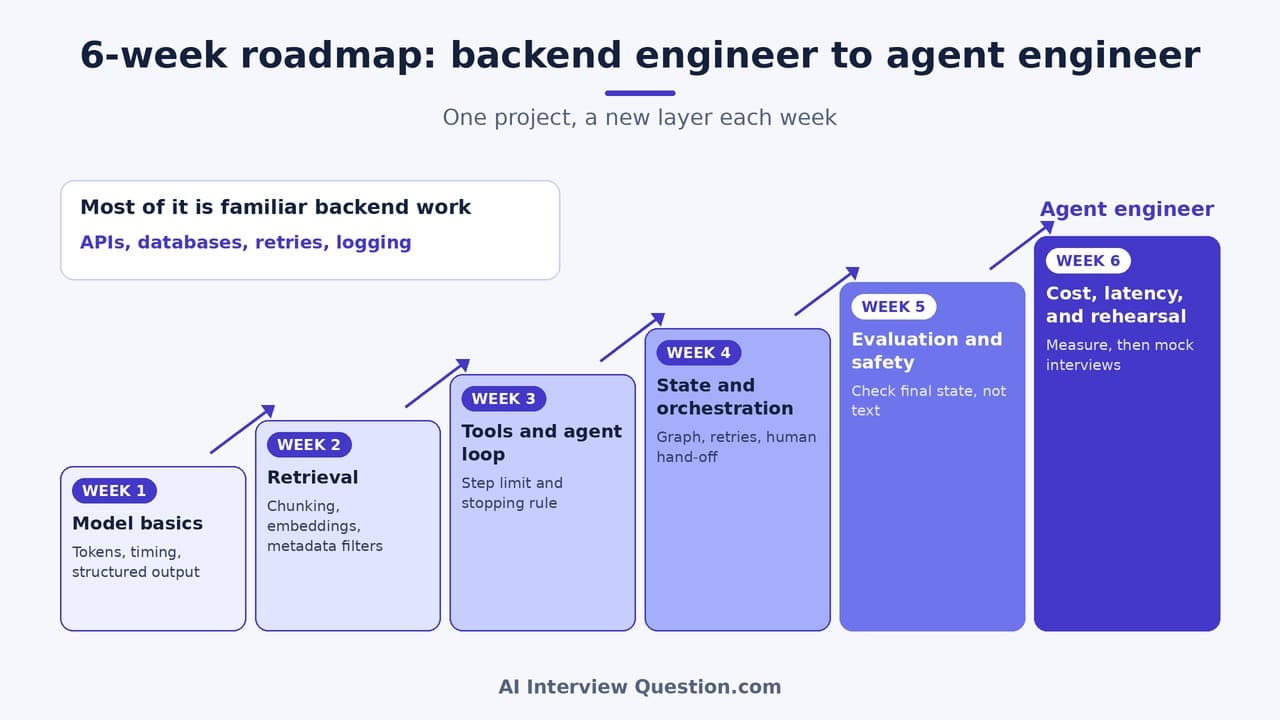
CareerA six-week roadmap for backend engineers moving into AI agents: model basics, retrieval, tool loops, orchestration, evaluation, then cost and rehearsal.
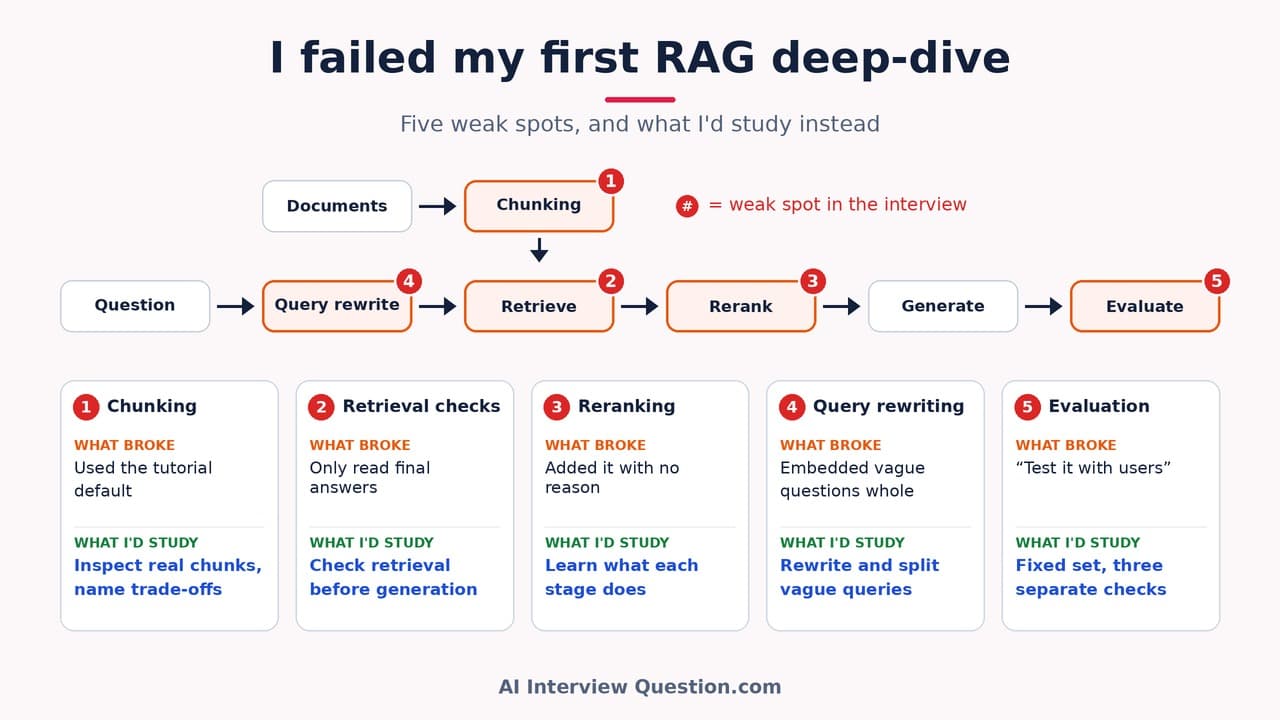
Interview PrepA composite story of a failed RAG deep-dive interview: chunking, retrieval checks, reranking, query rewriting, and evaluation, and what to study instead.
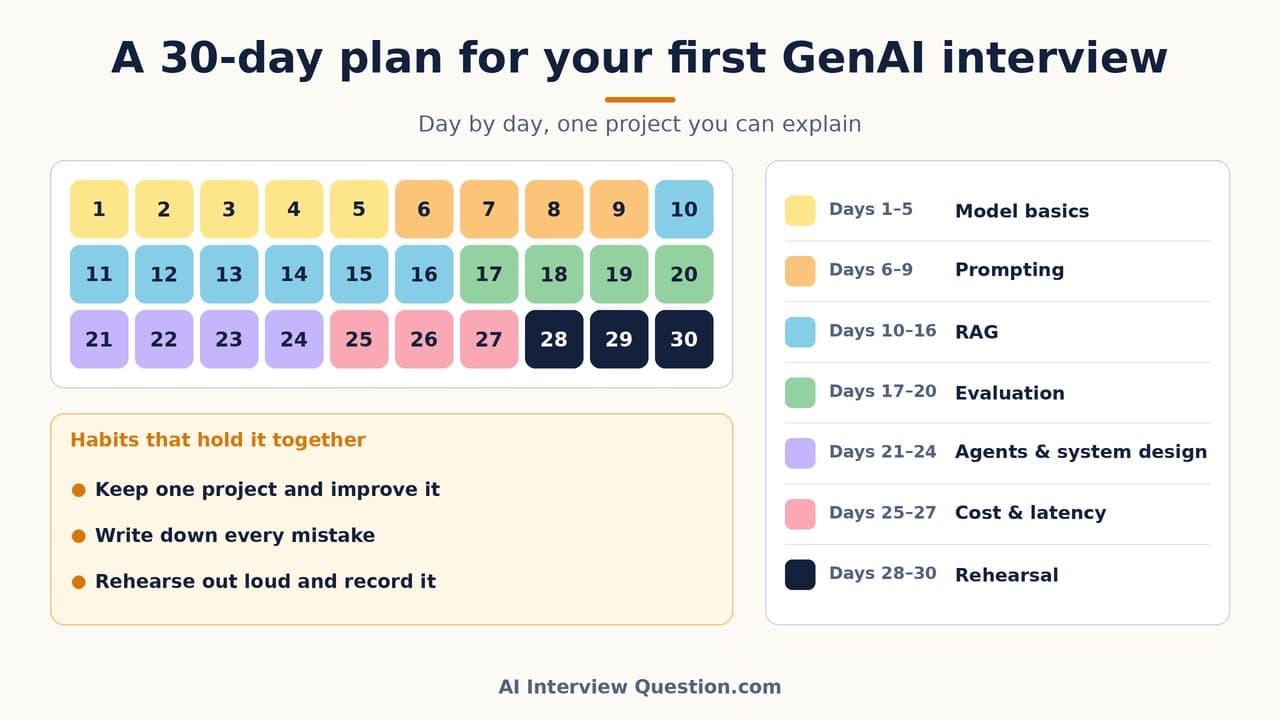
Interview PrepA day-by-day 30-day roadmap for your first GenAI interview: model basics, prompting, RAG, evaluation, agents, cost and latency, then mock rehearsal.
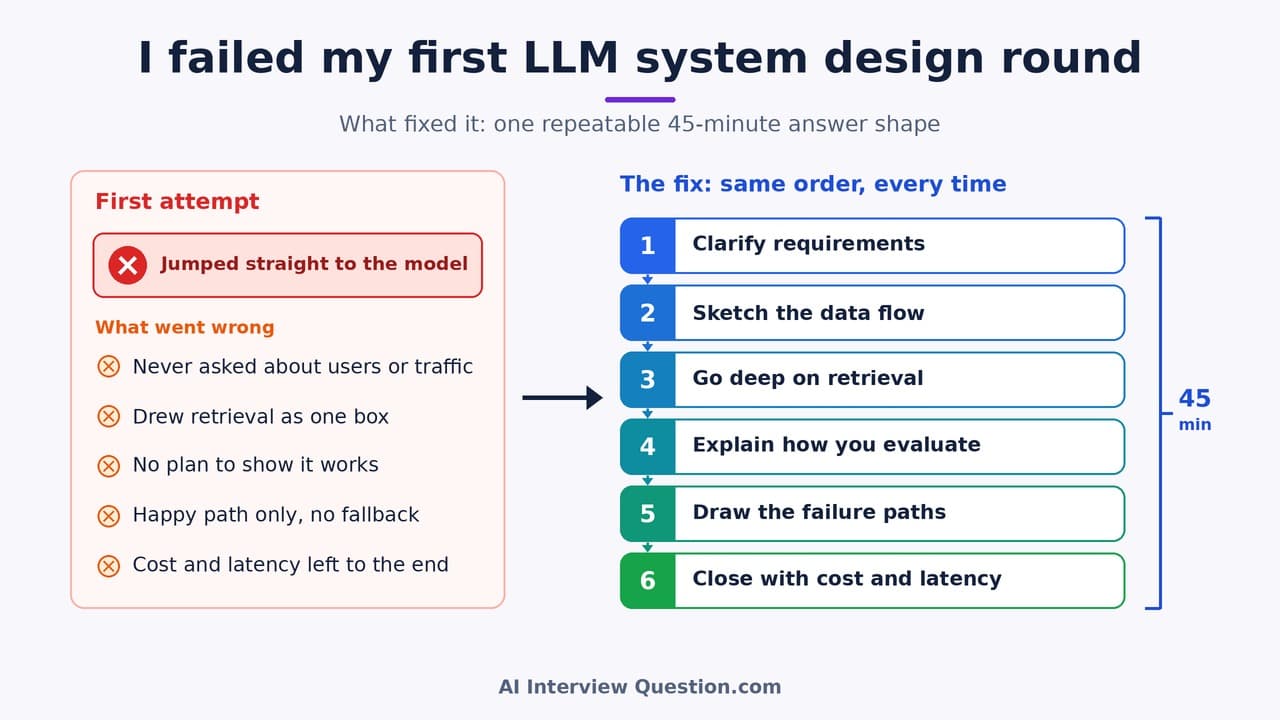
Interview PrepA composite story of a failed LLM system design interview: five mistakes, from skipping requirements to ignoring evaluation, and the habits that fixed them.
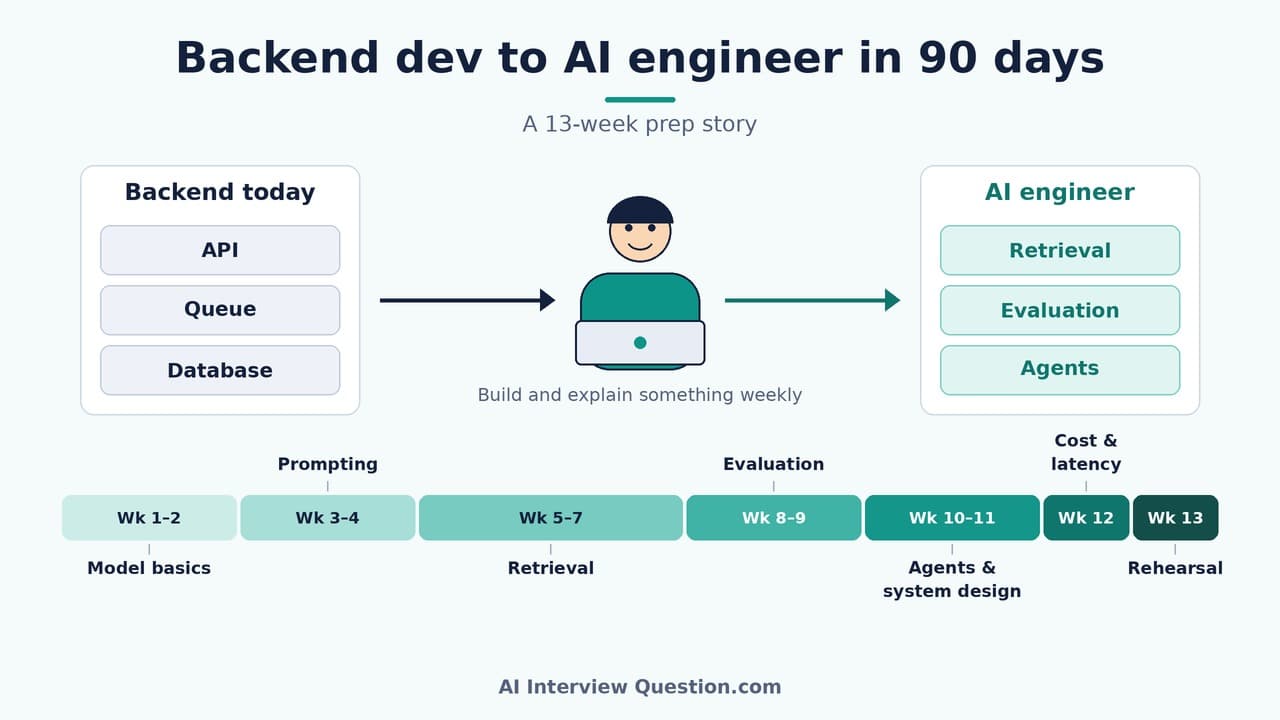
CareerA week-by-week story of a backend developer moving into AI engineering: what to study, the mistakes to avoid, and how one project carries the interview.
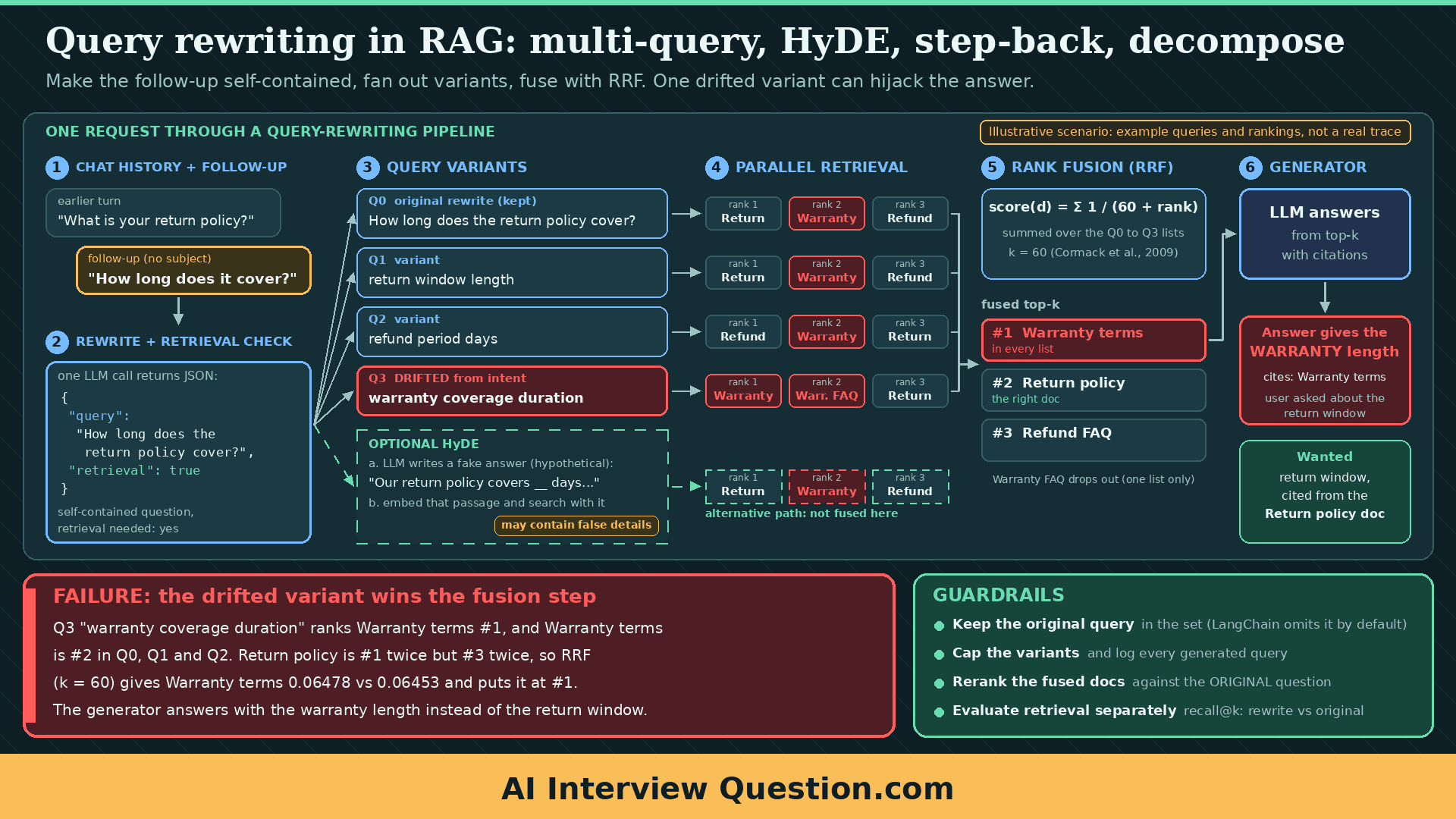
RAGQuery rewriting in RAG: contextualize follow-ups, then multi-query with RRF, HyDE, step-back, or sub-questions. Know the drift and latency interviewers probe.
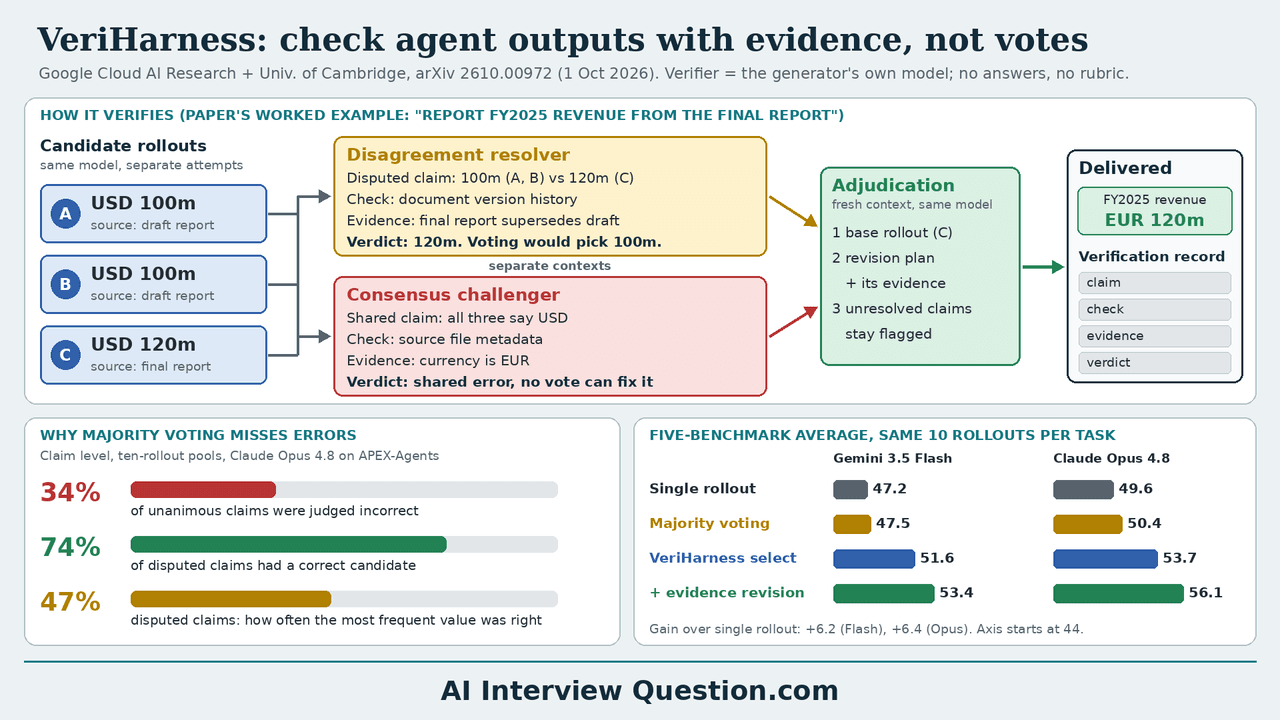
AI NewsGoogle Cloud AI Research's VeriHarness checks agent outputs against evidence, not votes: same model, no rubric, 6.2 to 6.4 points over a single rollout.
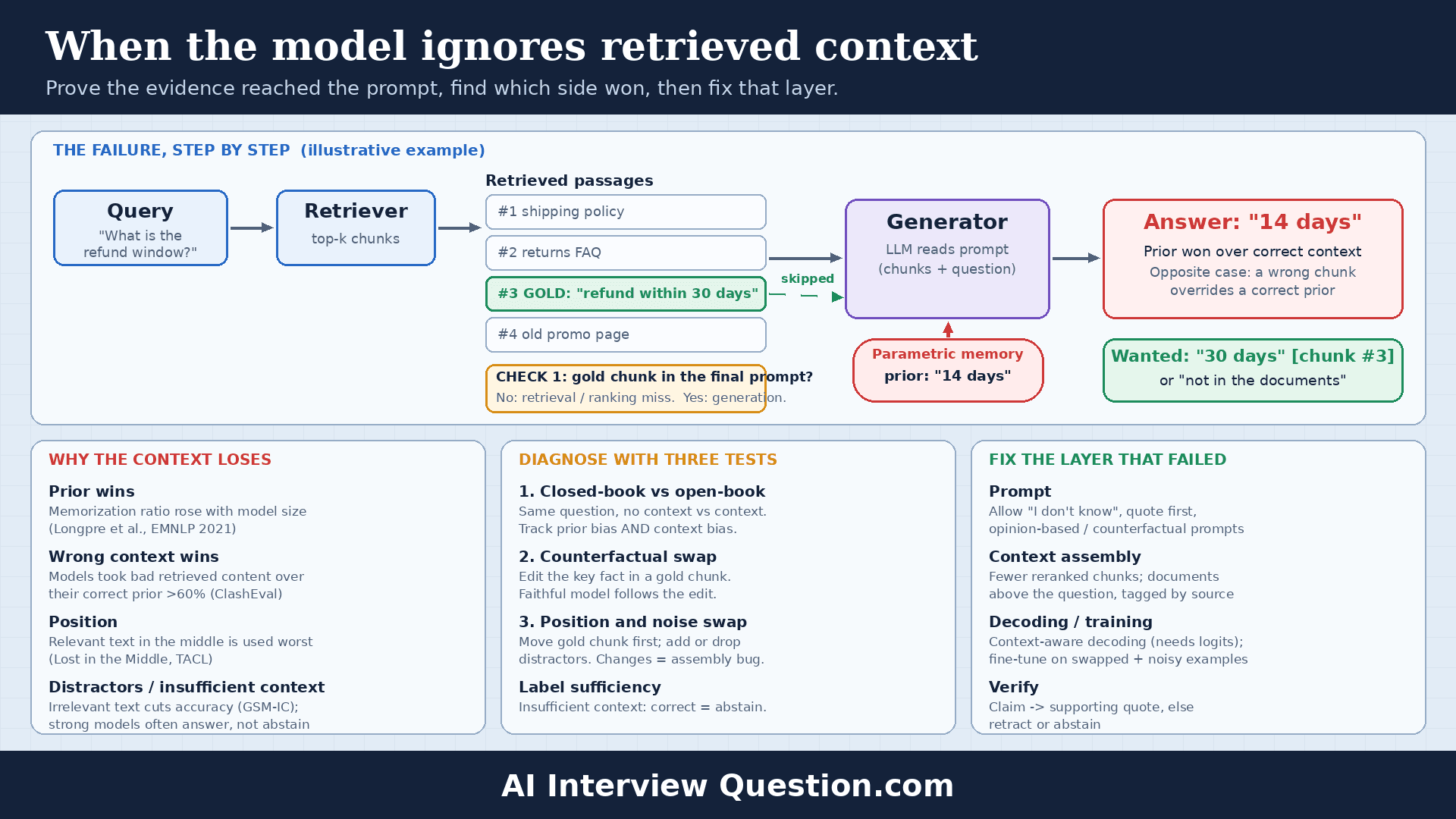
RAGRAG model ignoring retrieved context? Prove the gold chunk reached the prompt, find whether memory or a wrong chunk won, then fix the layer that failed.
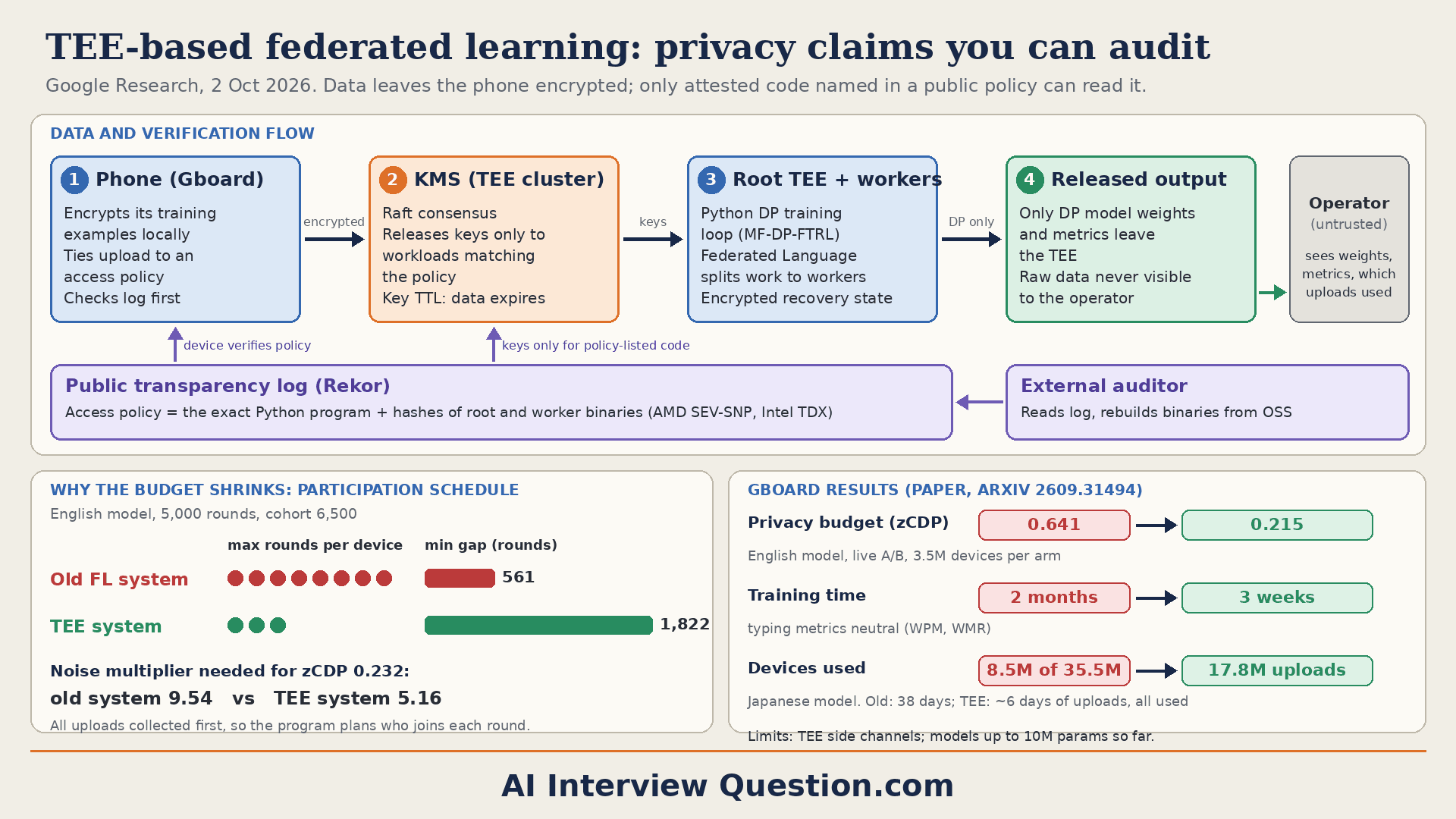
AI NewsOn 2 October 2026 Google Research detailed TEE-based federated learning for Gboard: a 3x smaller privacy budget and 3 weeks of training, not 2 months.
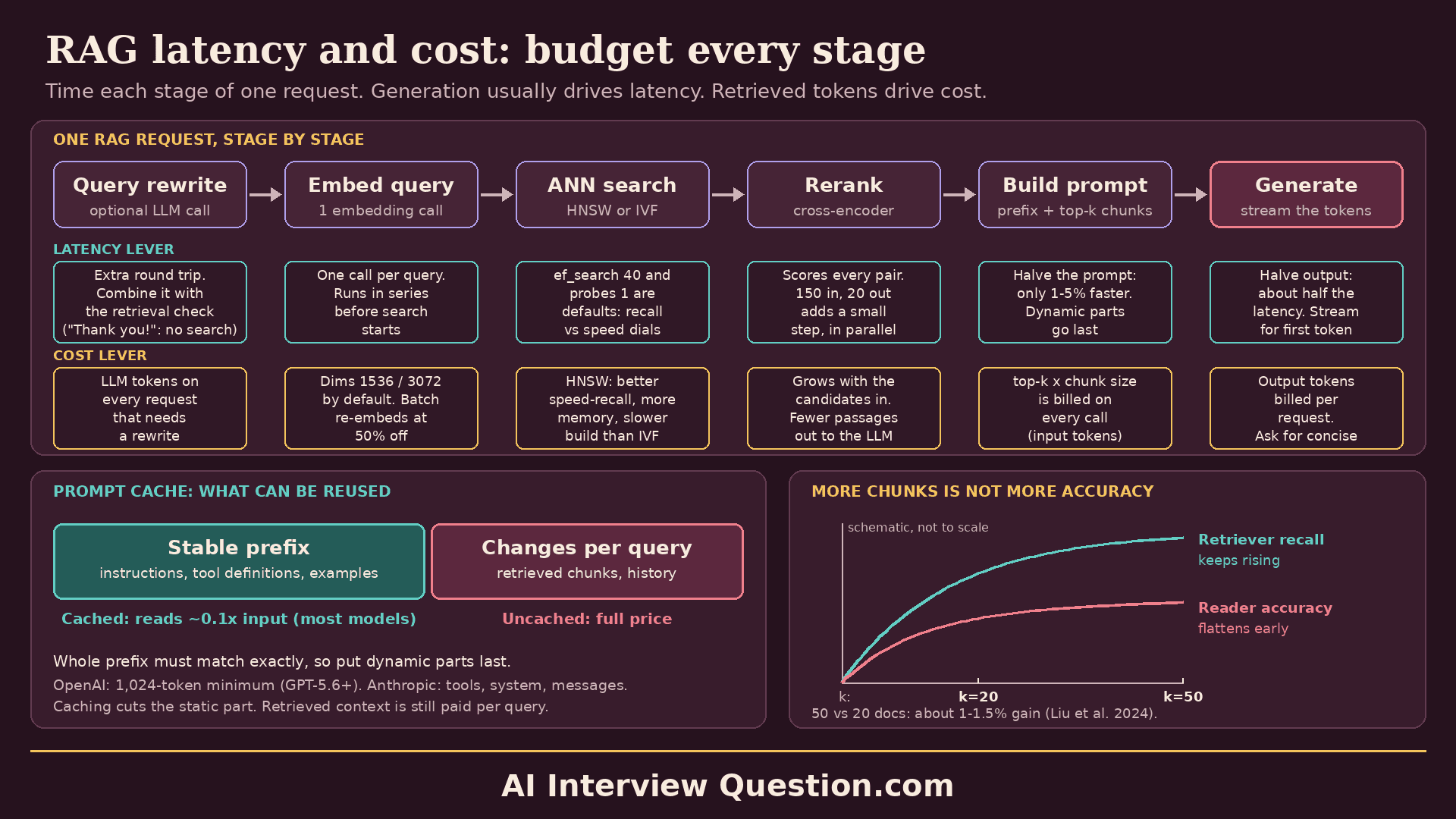
RAGBudget a RAG request stage by stage. Generation drives latency, retrieved tokens drive cost. Tune top-k, rerank depth, ANN dials, and caching against recall.
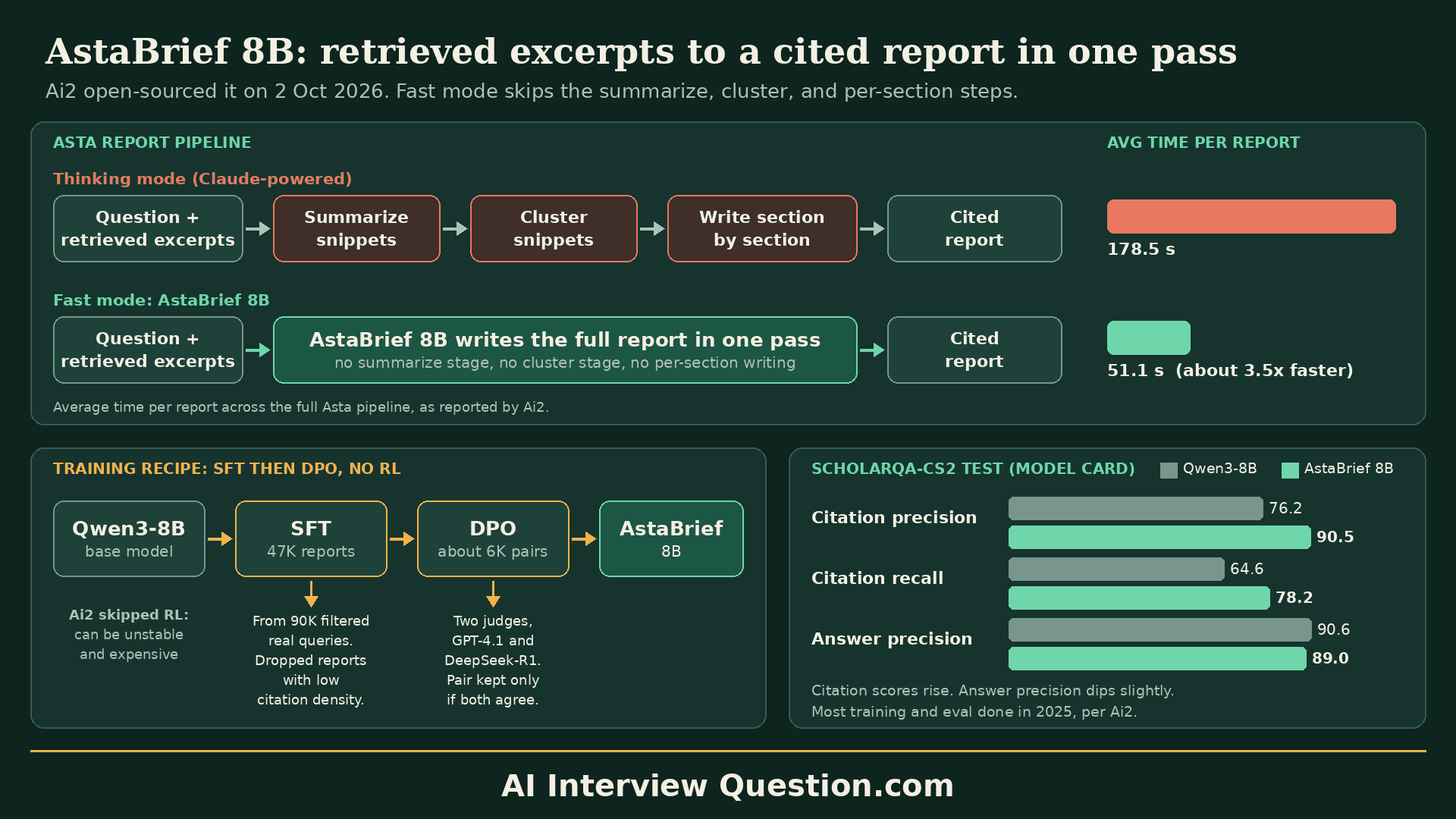
AI NewsAi2 open-sourced AstaBrief 8B on 2 October 2026. It writes a cited report from retrieved excerpts in one pass, 51.1 s vs 178.5 s, using SFT then DPO, no RL.
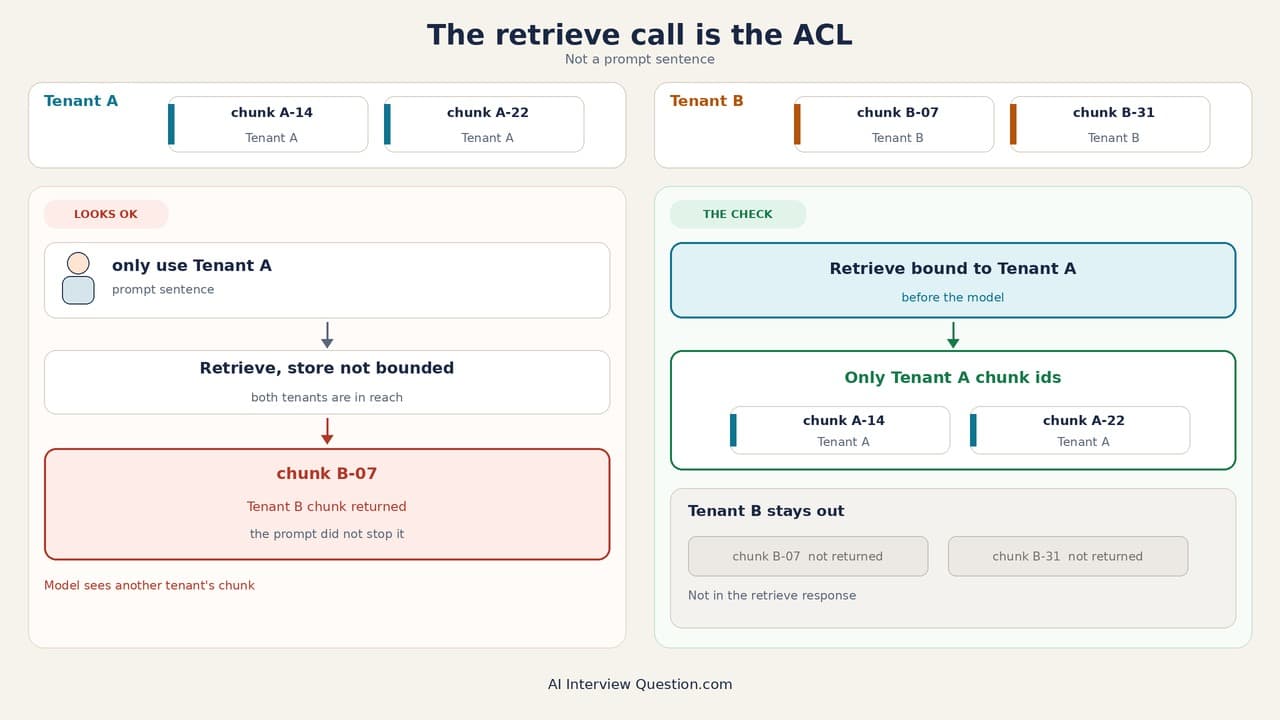
RAGA prompt line is not an ACL. Bound the store before the model sees another tenant's chunks, and judge the retrieve response, not the answer.
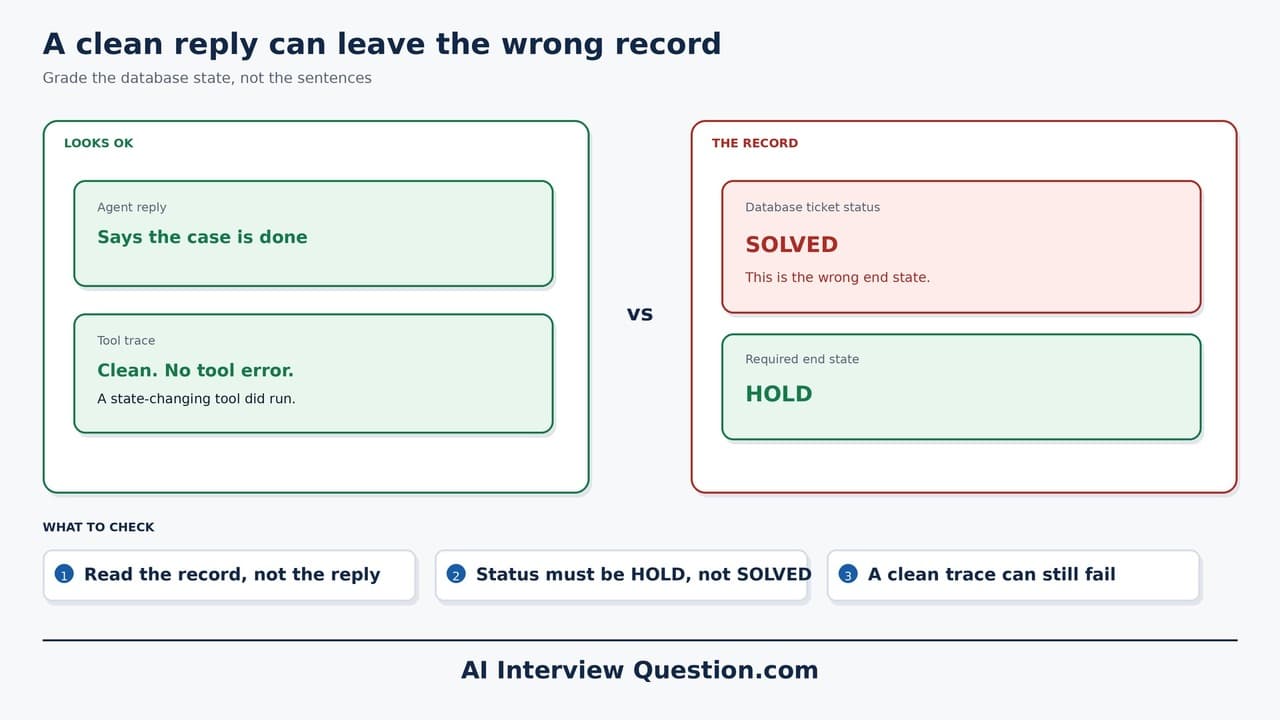
AI NewsMicrosoft and Hugging Face posted ThinkingBox on 3 October 2026. 477 of 507 workflows are graded on state alone. 30 add response rubrics.
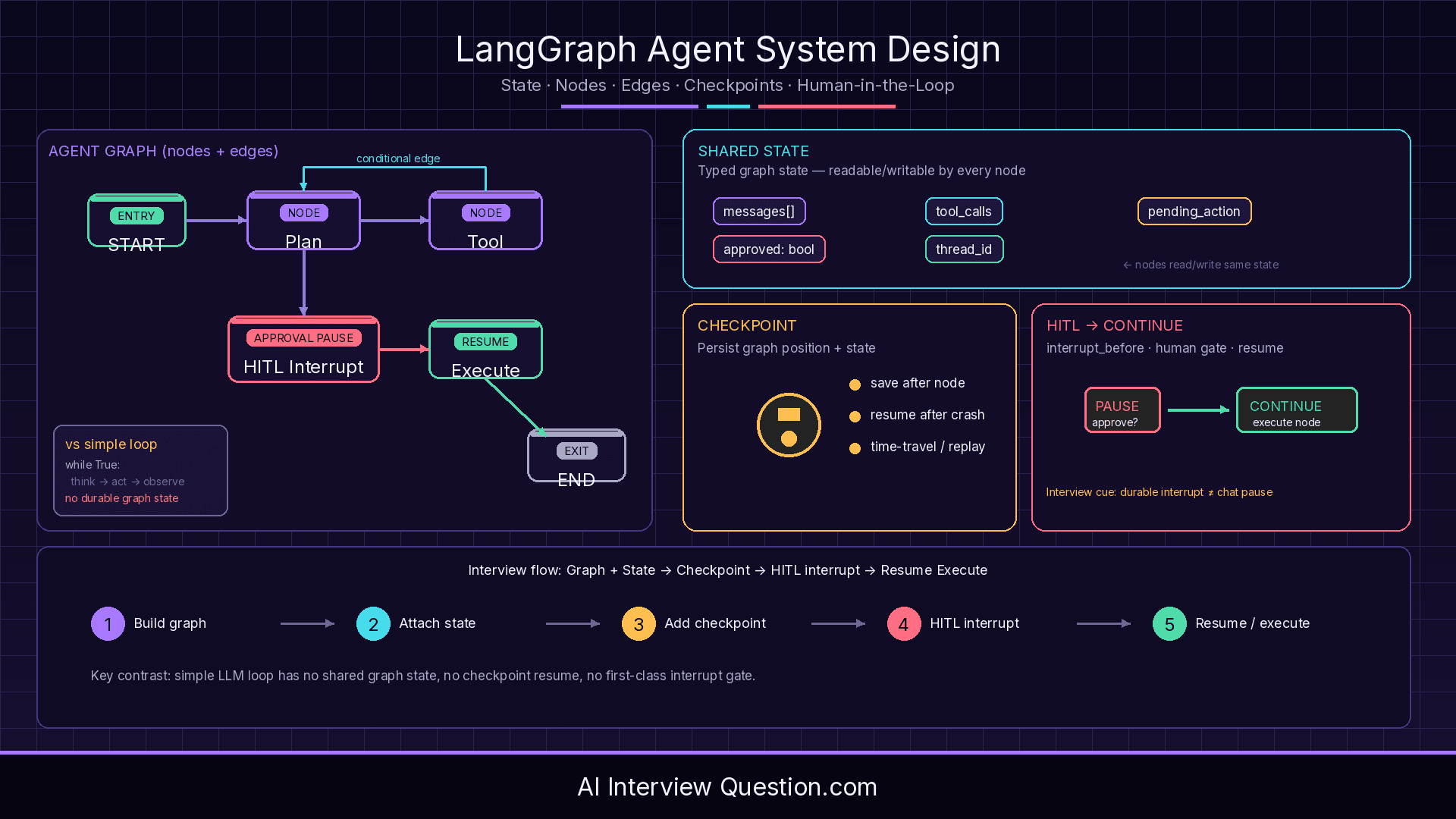
AgentsInterviewers probe durable agent workflows—shared state with reducers, routing and cycles, checkpoints, and human gates. How to design with LangGraph vs a simple ReAct loop.
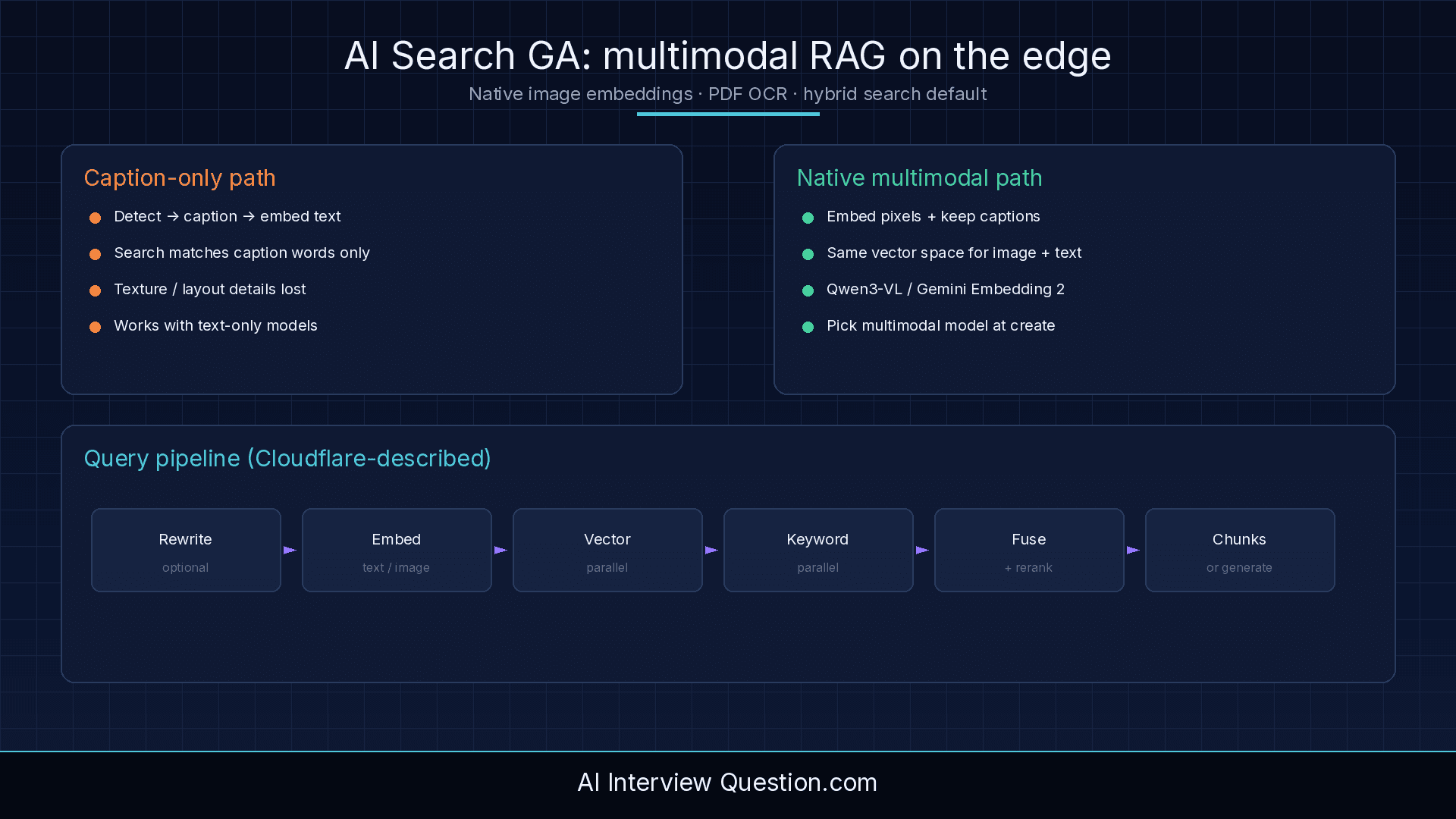
AI NewsOct 1, 2026: Cloudflare AI Search goes GA with native multimodal embeddings, PDF OCR, hybrid search by default, and billing from Nov 1—interview notes on the caption vs pixel fork.
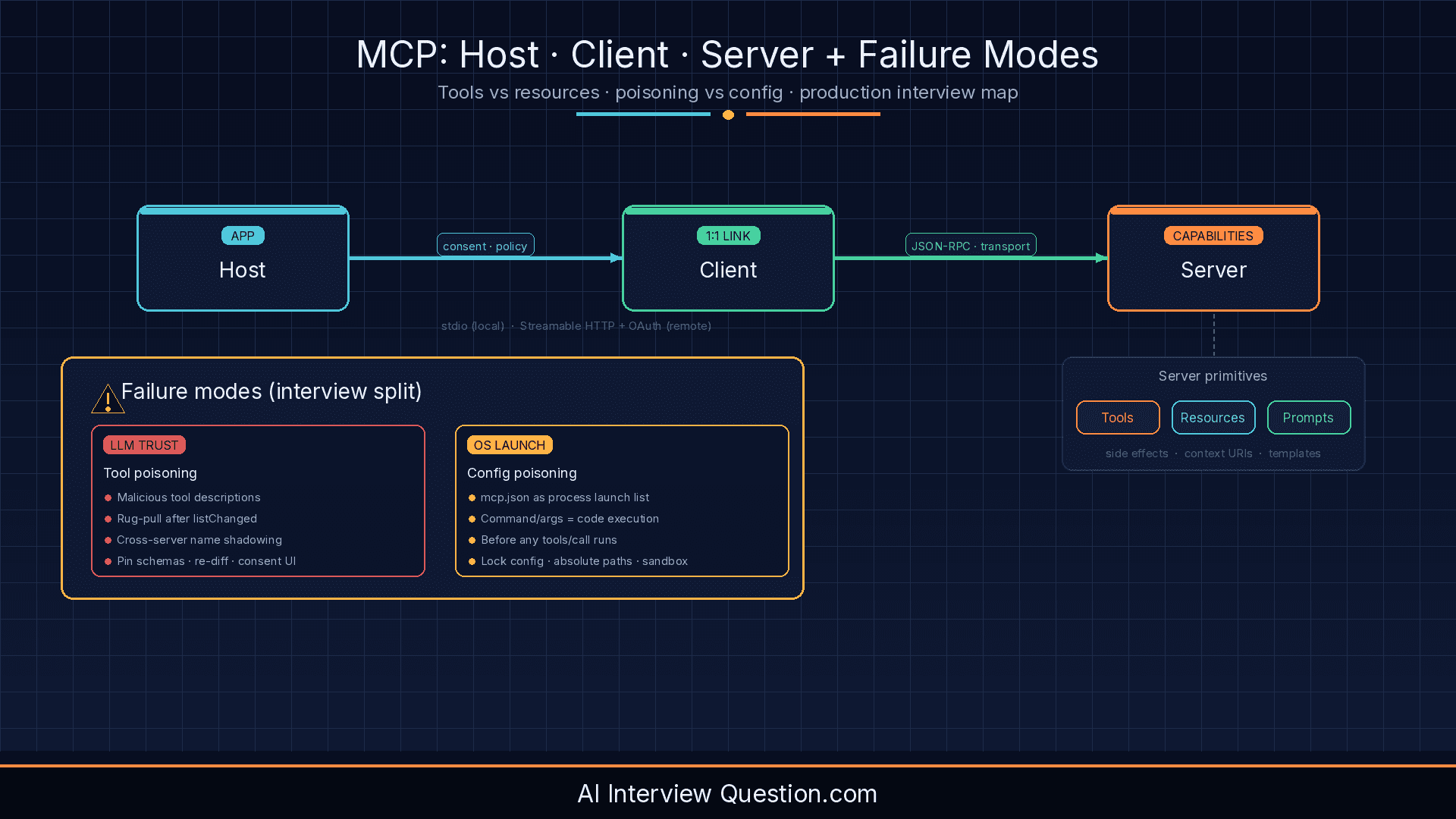
MCPMCP interview guide: tools, servers, and failure modes—tools vs resources vs prompts, tool poisoning vs config RCE, OAuth, production checklist.
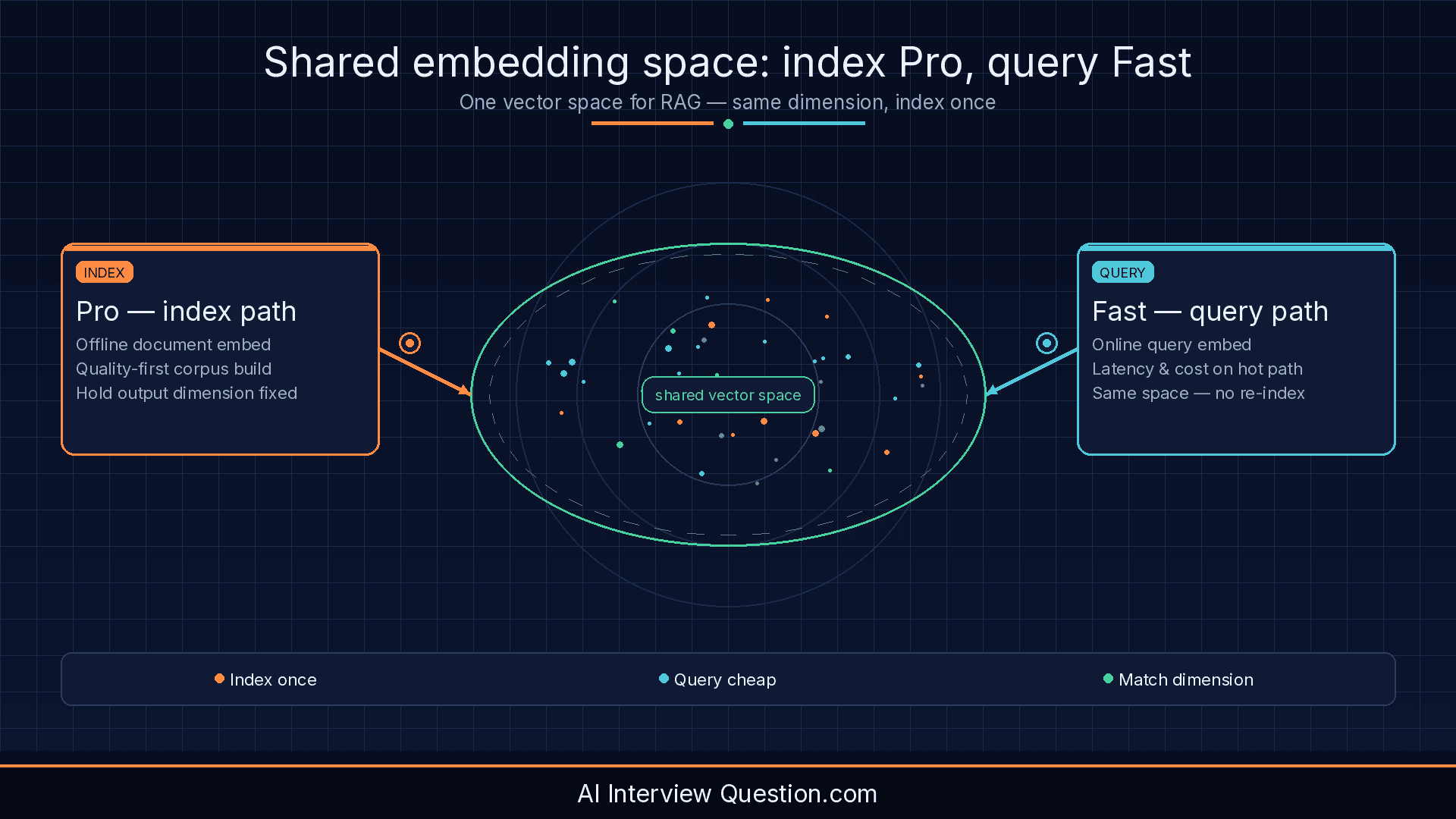
AI NewsSep 30, 2026: Cohere Embed 5 Pro and Fast share one embedding space—index with Pro, query with Fast (same dimension)—for cheaper RAG without a re-index
RAGChoose the model by retrieval task and corpus. Pair the query encoder with the document encoder. Swap the function and you rebuild the index.
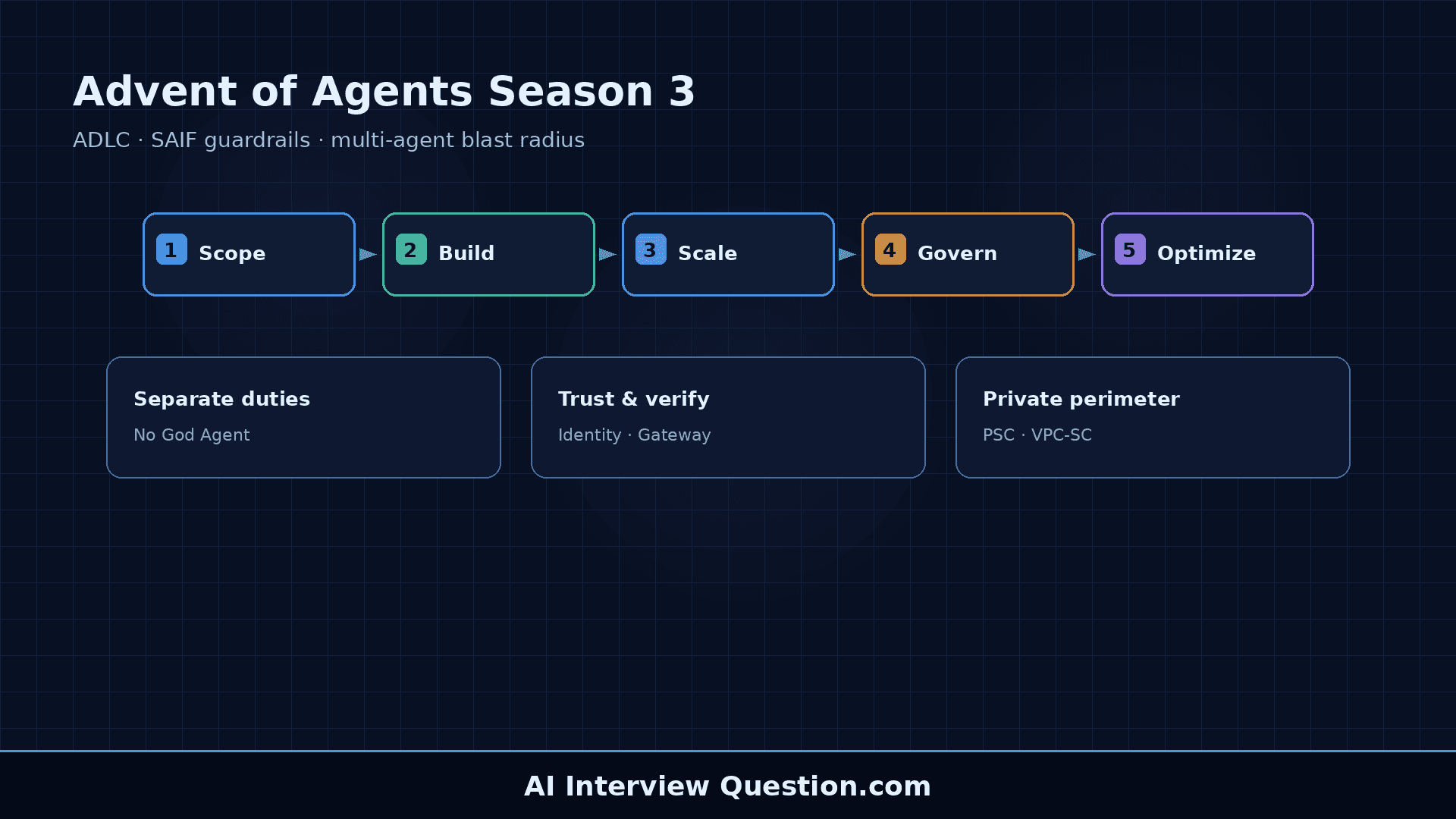
AI NewsOctober 2026 Advent of Agents Season 3: Scope→Build→Scale→Govern→Optimize, SAIF guardrails, and privilege-split multi-agent design for interviews.
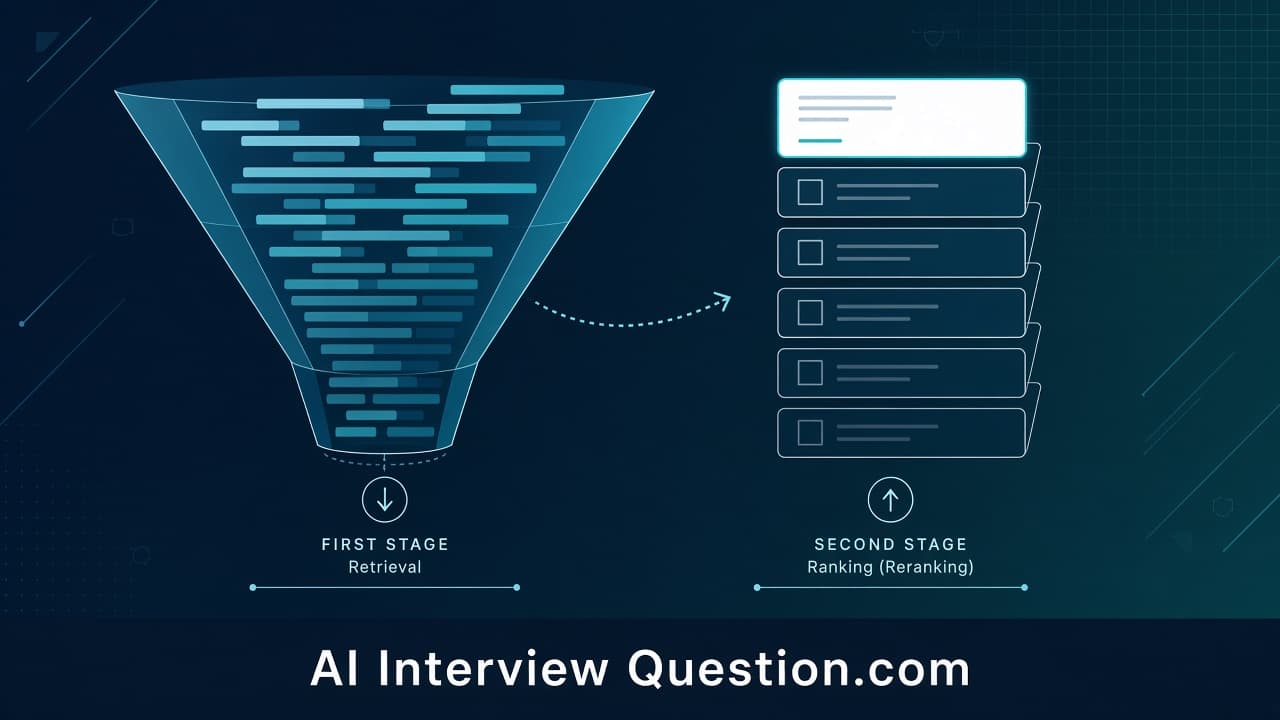
RAGRetrievers own recall; cross-encoders reorder a shortlist. Cite BEIR carefully, label vendor cost claims, and diagnose missing recall before you add latency.
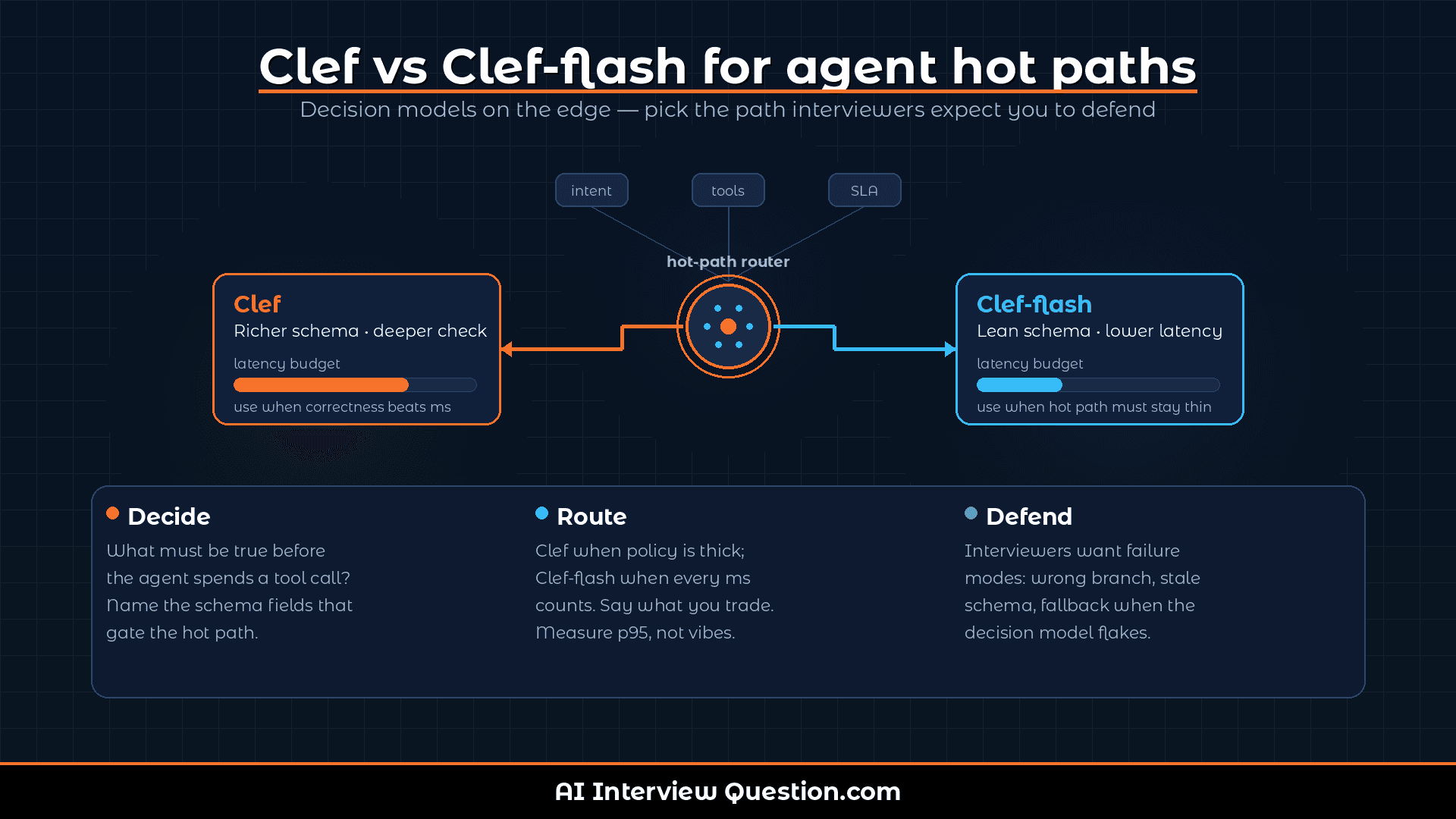
AI NewsOn October 1, 2026, Cloudflare shipped Clef and Clef-flash on Workers AI: open-weight (Apache-2.0), Jev-compatible decision models that return typed probabilities—not free-form text—for agent hot-path routing and guardrails.
RAGSeparate BM25 from dense retrieval, then fuse with reciprocal rank fusion. Cite the datasets where each wins. Do not average raw scores with cosine.
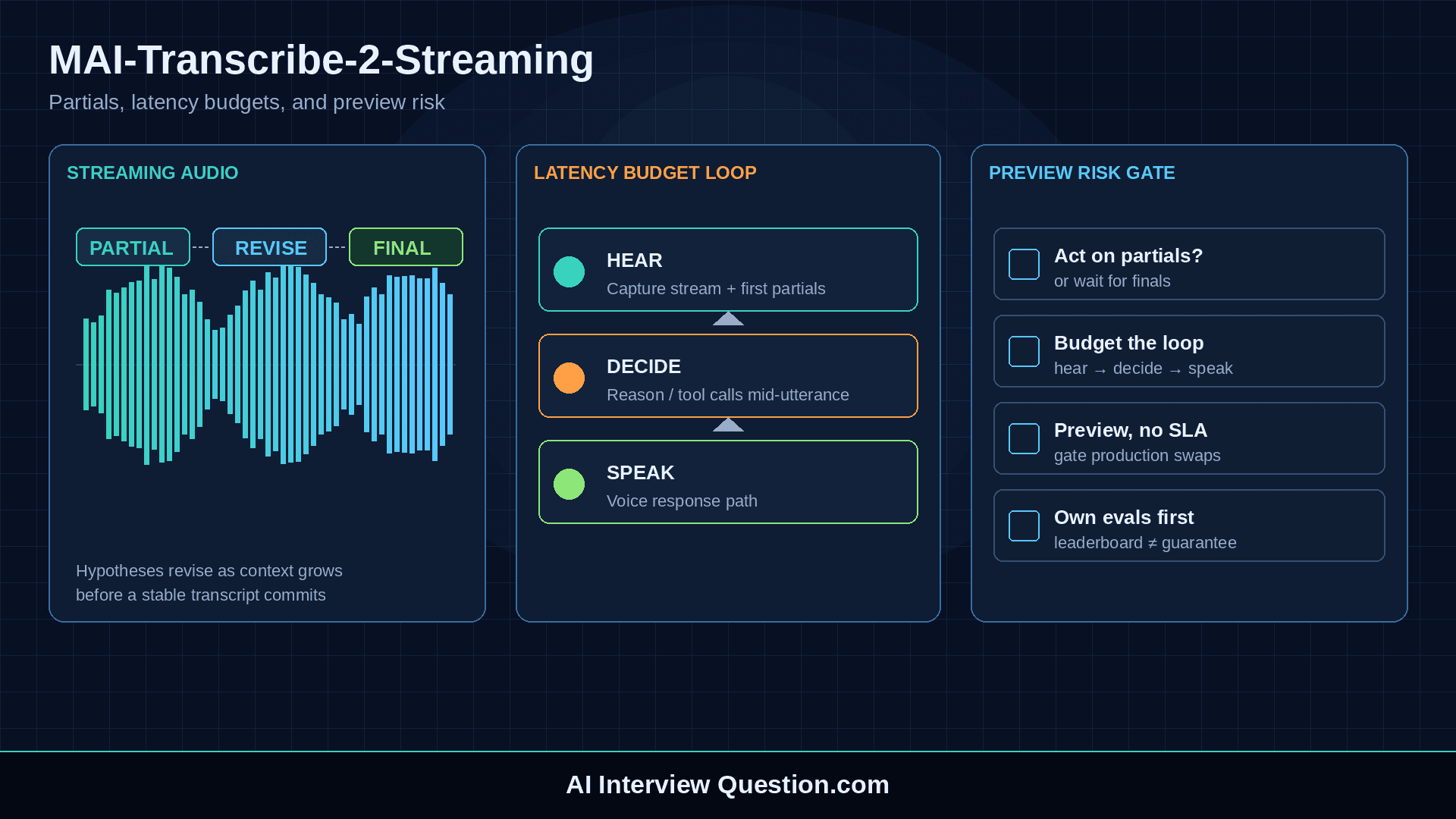
AI NewsMicrosoft shipped MAI-Transcribe-2-Streaming on 1 Oct 2026: partials in just over 100 ms, paired voice models, and a public-preview caveat for interviews.
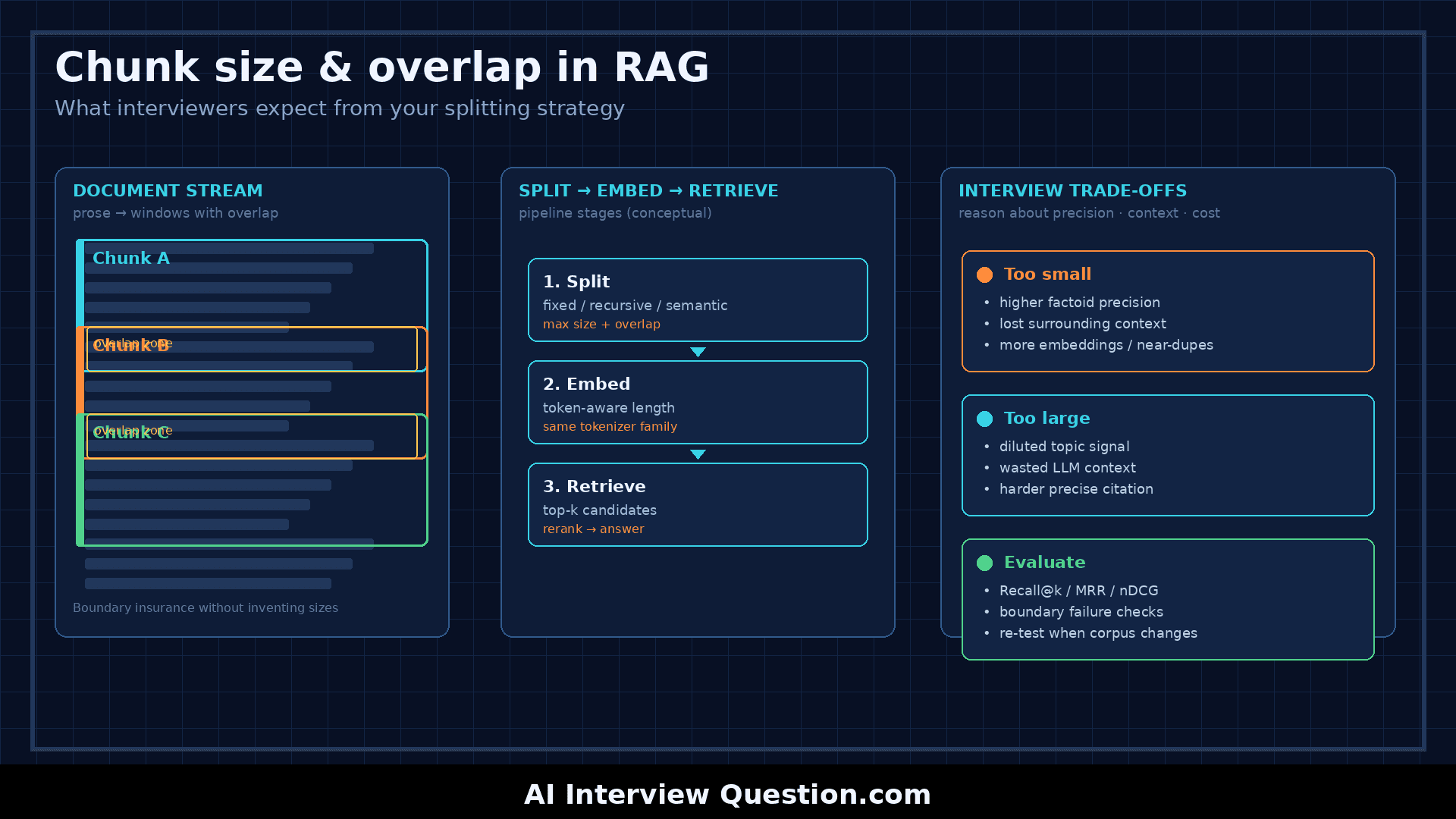
RAGInterviewers want chunk size and overlap trade-offs, not a magic default. Cover recursive vs fixed, tokens vs characters, and how you evaluate.
AI NewsAleph Alpha released Kolibri on 3 October 2026, an English–German open-weight model: 78.1 billion parameters total, 3.46 billion active per token.
AI NewsAnthropic stated a $100 million commitment to train 10,000 Frontier Deployed Engineers by the end of 2027. Entry is by nomination, not open enrollment.
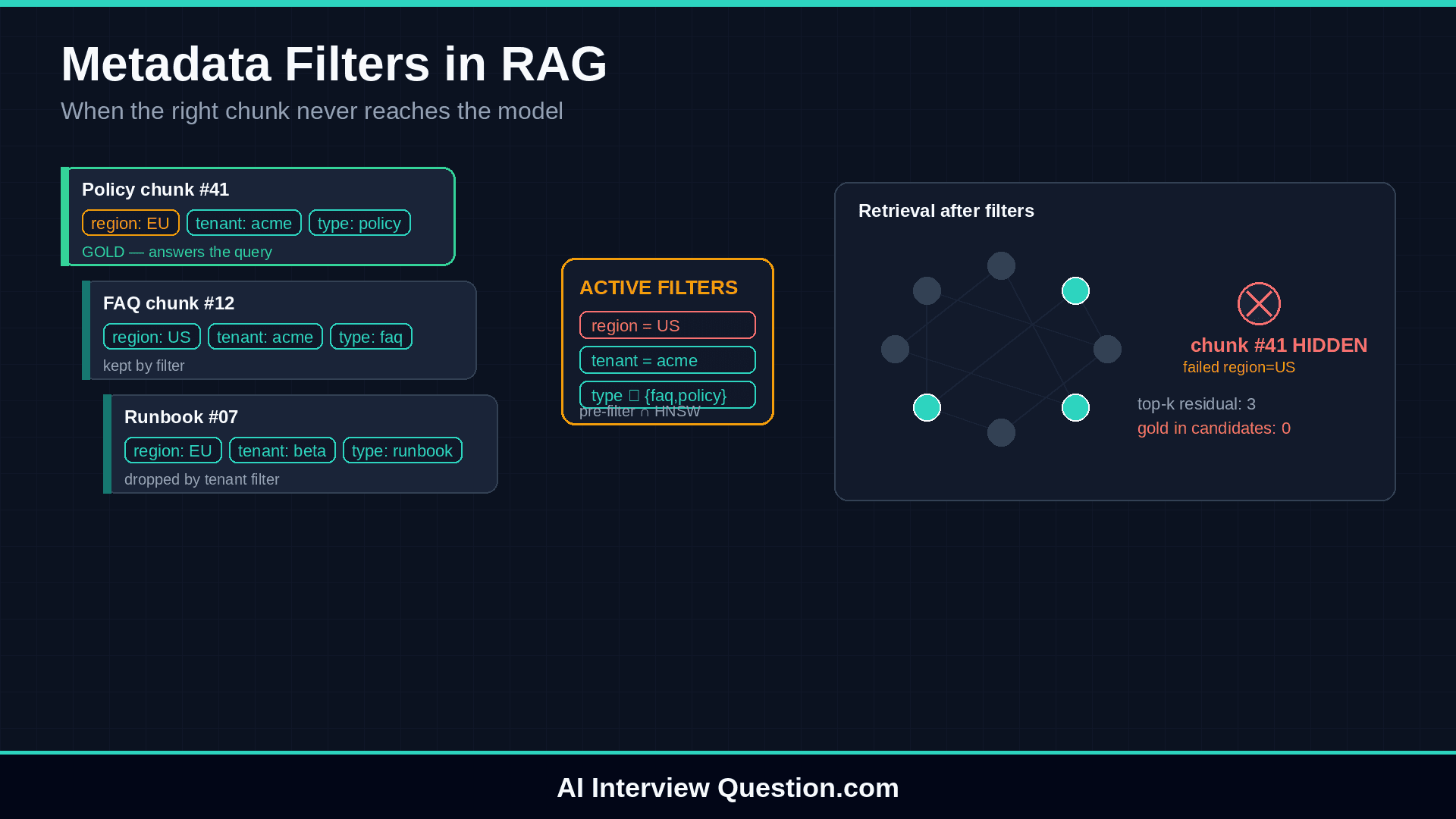
RAGMetadata filters can silently exclude the chunk that answers the question. Pre-filter vs post-filter, ACL traps, over-filtering, and interview debugging tips.
AI NewsGoogle announced Gemini 4 Argon on 30 Sep 2026 for trusted cyber defenders only. Here is what is real, what is still gated, and what to say in an interview.
RAGWrong RAG answers are usually retrieval, filters, or ranking, not the model. Split the failure, then fix chunks, top-k, rerank, and citations.
LLMsInterviewers will ask you to separate a cheaper model from one that missed the deployment bar. Capability, access, and price are three different answers.
Advanced RAG interviews test agentic retrieval loops, GraphRAG trade-offs, corrective and self-RAG patterns, and when complexity actually improves answer quality.
Behavioral AI interviews test whether you have shipped real systems—production incidents you resolved, cost-quality trade-offs you navigated, and how you communicate uncertainty to stakeholders.
Deep learning production interviews cover training instability, distributed training basics, GPU memory management, and when custom DL beats pre-trained foundation models.
ML interviews test when gradient boosting still beats deep learning, how you calibrate probabilities, and how classical models integrate alongside LLM components.
AI fundamentals interviews in production roles connect precision-recall trade-offs, data leakage, and bias-variance to real system failures—not undergraduate exam questions.
Vision production interviews test inference pipelines, model selection for detection versus classification, content moderation, and monitoring for data drift in visual inputs.
Multimodal RAG interviews cover chart understanding, visual PDF ingestion, cross-modal retrieval, and citation strategies when answers depend on images—not just text chunks.
Provider interviews test multi-vendor routing, SLA trade-offs, data residency, pricing models, and eval-driven model selection—not brand loyalty.
Production interview guide for LLM cost and latency — caching, routing, streaming, rate limits, and semantic caches.
Interview prep for LLM evaluation — classic metrics limits, LLM-as-judge design, offline vs online eval, and red-teaming.
Observability and evaluation for coding agents — traces, cost/quality metrics, alerts, and private-repo bakeoffs.
Threat model MCP coding agents — prompt injection, malicious servers, .mcp.json attacks, and runtime governance.
Enterprise AI governance for coding agents — approval workflows, least privilege, sandboxes, and AI platform engineering ownership.
Framework interviews test when to adopt orchestration libraries, how abstractions help or hurt debuggability, and how you avoid framework lock-in on critical paths.
What belongs in AGENTS.md, why concise files win, company-wide templates, and securing agent config against repo attacks.
From prompt engineering to context engineering — budgets, retrieval, compression, and company-wide repository context.
Handbook-style interview prep: why LLMs hallucinate, hallucination types, and production defenses (RAG, guardrails, citations, eval) — asked at OpenAI, Google, Meta, Anthropic, Microsoft, and Amazon.
Interview guide for Claude Code — CLI coding agents, AGENTS.md workflows, sandboxes, and how Claude Code compares to Cursor and Copilot.
Cursor vs GitHub Copilot interview prep: codebase indexing, agent edits, .cursor/rules, enterprise fit, and review gates.
OpenAI Codex CLI interview guide — when to use a CLI coding agent vs Copilot, plus cost optimization for high-volume agent jobs.
Model Context Protocol interview guide: hosts, clients, servers, agent gateways, and enterprise MCP deployments.
System design for AI coding agents — planner, tools, memory, verifiers, MCP, sandboxes, and a platform for 1,000 engineers.
Python interviews for AI roles test FastAPI service design, async I/O with LLM clients, Pydantic validation, and memory-safe batch processing—not trivia about the GIL.
MLOps interviews for GenAI cover prompt CI/CD, model routing changes, drift detection, cost observability, and incident response when quality cliffs appear after deploy.
Support system design interviews test ticket retrieval, action tools, human handoff, and how you measure resolution rate without sacrificing safety or CSAT.
Design interviews for enterprise RAG platforms test ingestion scale, ACL-aware retrieval, eval infrastructure, and operability across hundreds of document sources.
Inference interviews test continuous batching, KV cache memory math, quantization trade-offs, speculative decoding, and how p99 latency budgets drive architecture.
AI security interviews cover prompt injection, jailbreaks, RAG poisoning, tool abuse, and red-team programs that produce fixes—not just findings slides.
Evaluation interviews test pipeline design: golden datasets, LLM judges, human rubrics, CI gates, and how online metrics close the loop with offline benchmarks.
MCP security interviews focus on permission models, tool poisoning, prompt injection via resources, and why agent tool access is as sensitive as database credentials.
MCP interviews cover client-server boundaries, gateway patterns, transport choices, and how to scale tool ecosystems without creating undebuggable agent spaghetti.
Multi-agent interviews examine supervisor patterns, delegation protocols, shared state consistency, and cost explosion when agents talk too much to each other.
Agent interviews test planner-executor design, tool validation, memory boundaries, and how you prevent infinite loops—not whether you can spell ReAct.
SLM interviews focus on when smaller models beat frontier APIs: latency budgets, on-device privacy, distillation pipelines, and quantization for CPU inference.
Alignment interviews cover preference data quality, DPO versus PPO trade-offs, reward hacking, and how post-training choices affect downstream agent reliability.
Interviewers want a decision framework—not a tribal preference. Learn when fine-tuning, RAG, or both wins on freshness, cost, compliance, and evaluability.
Production prompt engineering is software engineering: versioned templates, eval gates, structured outputs, and defenses against injection—not clever one-shot phrasing.
Vector DB interviews cover HNSW parameter tuning, hybrid retrieval, metadata filtering at scale, and when to use pgvector versus dedicated vector platforms.
Embedding interviews test re-embedding strategy, cosine similarity pitfalls, domain adaptation, and how silent embedding drift destroys retrieval quality overnight.
Vector DatabasesANN search, hybrid retrieval, and scaling to 500M vectors — system design for vector DB interviews.
Transformer interviews for AI engineers emphasize attention complexity, KV cache behavior, positional encoding trade-offs, and how architectural choices affect inference cost—not hand-waving about self-attention.
Go beyond transformer trivia. Production LLM interviews test token budgets, decoding behavior, hallucination patterns, and how model limitations shape system architecture.
Chain-of-thought, few-shot, and evaluation strategies — the craft behind reliable LLM outputs.
Learn how to debug RAG regressions by separating retrieval failures from generation drift, building slice-aware eval pipelines, and choosing metrics that actually predict user pain.
State machines, cyclic workflows, and the Model Context Protocol — essential for agent infrastructure interviews.
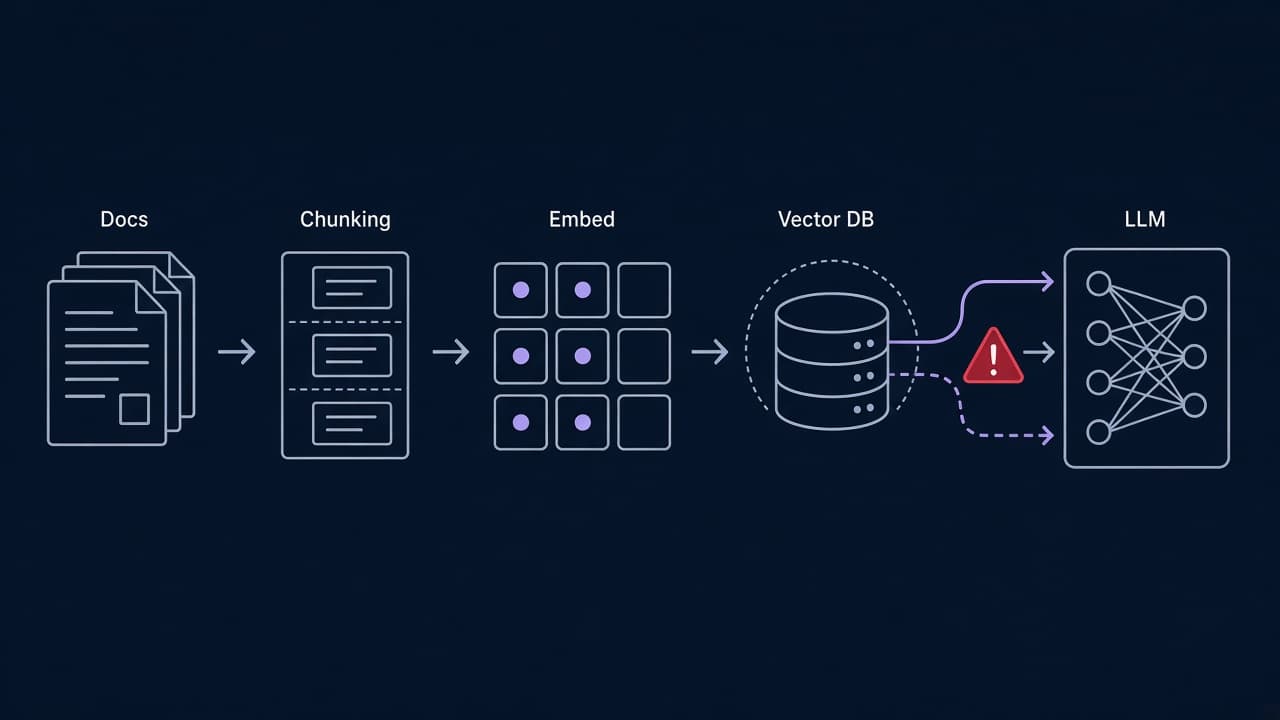
Production RAG interviews test whether you can ship retrieval systems that stay grounded under real traffic, tenant isolation, and document churn—not whether you can draw a naive retrieve-then-generate diagram.
Model-based interview questions for every major LLM family — know the trade-offs before you walk in.
Master multi-agent systems, tool use, and agent orchestration — the hottest topic in GenAI hiring loops.
Everything you need to ace RAG interviews — from fundamentals and hallucination mitigation to enterprise pipeline design.