Evaluate Planner-Executor quality in an AI search product
Staff evaluation interview question on Planner-Executor within AI Agents.
Read full explanationA three-week plan for your first AI agent interview: build the loop and tools, make them safe and dependable, then prove and explain the agent you built.
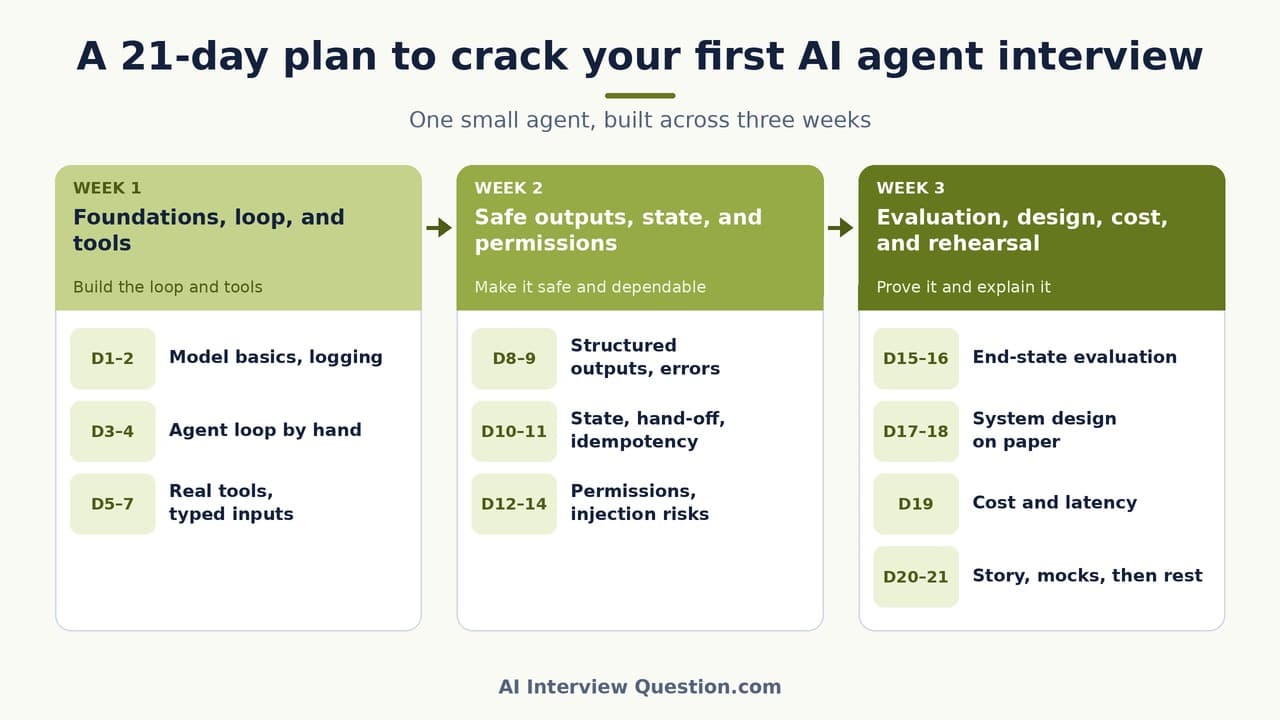
Twenty-one days is enough to get ready for a first AI agent interview if you already code comfortably and have used a language model API. The plan builds one small agent across three weeks, so every topic you study turns into something you can show and explain. Give it a couple of focused hours on weekdays and a longer session on weekends, and stretch it if you need to.
Week 1 is foundations. On days 1 and 2, learn tokens, context windows, sampling settings, and structured output, and write a small client that logs every model call with token counts and timing. On days 3 and 4, write the agent loop by hand: the model picks a tool, your code runs it, the result goes back, and the loop ends when the model answers or a step limit is hit. On days 5 to 7, add two or three real tools, such as search, reading a file, and one internal API, and give each one a precise name, typed inputs, and a description of when to use it. The agents prep guide at /blog/ai-agents-interview-prep covers the concepts behind this week.
Week 2 is making the agent safe and dependable. On days 8 and 9, design tool outputs and errors carefully: short, structured results, and error messages that tell the model whether to retry, ask the user, or stop. On days 10 and 11, add state you can print at every step, branches for retry and hand-off to a human, and idempotency for anything that changes data. On days 12 to 14, handle permissions and risk: check authorization inside the tool using the caller's identity, require confirmation for actions that cannot be undone, and think through prompt injection from tool results. The MCP tools and server failure modes guide at /blog/mcp-tools-servers-failure-modes-interview and the MCP security guide at /blog/mcp-security-interview-questions are the reading for this stretch.
Week 3 is proving it and explaining it. On days 15 and 16, build a small set of tasks with the expected end state for each, and check the records the agent changed, not only what it said. The LLM evaluation guide at /blog/llm-evaluation-interview-guide covers how to frame that. On days 17 and 18, practice agent system design on paper with a timer, using the LangGraph agent system design guide at /blog/langgraph-agent-system-design-interview-guide as your structure. On day 19, measure cost and latency across model calls and tools, and note what caching or a smaller model would change. The LLM cost and latency guide at /blog/llm-cost-latency-interview-guide helps here. On days 20 and 21, write a five-minute story of your agent, do two mock interviews out loud, and rest before the real thing.
A few habits hold the plan together. Keep one agent and keep deepening it. Write down every failure you hit, because those are your best interview stories. And when you are asked something you have not built, say what you would check first. If you are coming from backend work, the six-week roadmap at /blog/backend-to-agent-engineer-6-week-roadmap is a longer version of the same path.
Deep explanations with architecture diagrams for every question below.
Staff evaluation interview question on Planner-Executor within AI Agents.
Read full explanationMid-Level evaluation interview question on Planning within AI Agents.
Read full explanationStaff implementation interview question on Planner-Executor within AI Agents.
Read full explanationStaff trade-off interview question on Planner-Executor within AI Agents.
Read full explanationMid-Level production incident interview question on Planning within AI Agents.
Read full explanationMid-Level security interview question on Planning within AI Agents.
Read full explanationSenior scenario interview question on Agent Evaluation within AI Agents.
Read full explanationJunior trade-off interview question on Agent Memory within AI Agents.
Read full explanation