Debug Agent Permissions regression in a multi-tenant AI support platform
Staff debugging interview question on Agent Permissions within AI Agents.
Read full explanationOctober 2026 Advent of Agents Season 3: Scope→Build→Scale→Govern→Optimize, SAIF guardrails, and privilege-split multi-agent design for interviews.
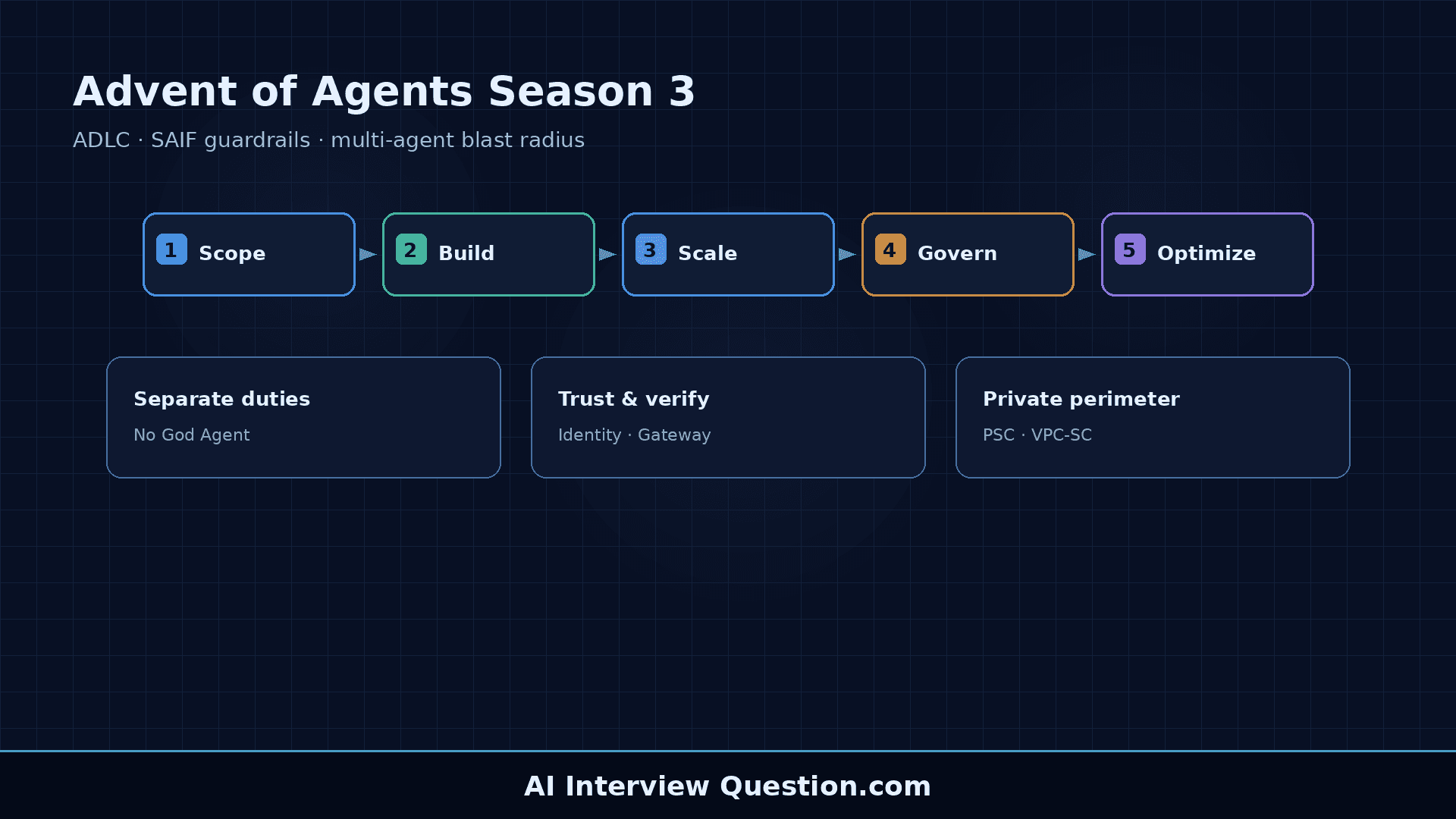
In early October 2026, Google’s Advent of Agents Season 3 opened on adventofagents.com with a daily sequence of production-agent tutorials. The first three lessons are already the interview-useful core: an Agent Development Lifecycle (ADLC) map, SAIF-based guardrails, and a hardened multi-agent reference architecture. For candidates, the news is not “another tutorial list.” It is a shared vocabulary for how serious teams scope, evaluate, and contain agents that choose tools at runtime.
Day 1 frames ADLC as a loop with five checkpoints: Scope, Build, Scale, Govern, and Optimize. Scope comes first: write what the agent may do, what it must never do, which data it touches, and who owns it. Advent treats a DESIGN_SPEC.md as the first governance artifact, not an afterthought README. Build means scaffolding with Agents CLI and ADK, then iterating locally with agents-cli run until every tool call in the trace matches that spec. Scale is deployment to Agent Runtime, Cloud Run, or GKE with infrastructure as code. Govern adds agent identity, registration, an Agent Gateway, and Model Armor screening. Optimize closes the loop: re-run evals on every change, trace tool calls with OpenTelemetry, and feed failures back into Scope.
That contrast is what interviewers want to hear. Classic SDLC assumes deterministic code, so unit tests can prove correctness. MLOps adds data and model drift, but a model still returns predictions. An agent decides which tools to call after you ship it. Advent’s Day 1 wording is blunt: ADLC adds evaluating behavior—the tool trajectory, not only the final answer—and governing what the agent is allowed to reach. If your interview answer stops at “we prompt-engineered carefully,” you are still stuck in demo-land.
The Season 3 Day 1 path also names concrete tooling you can cite without inventing a personal production story. The lesson walks through uvx google-agents-cli setup, scaffolding a prototype agent, running a query while reading the tool_call audit line, then agents-cli eval run. Supporting Google Codelab and Agents CLI docs describe the same production loop: scaffold, evaluate tool trajectories plus rubric-scored responses, deploy, observe. Agents CLI’s own lifecycle guide expands the loop into finer phases (spec, scaffold, build, orchestrate, evaluate, deploy, publish, observe). Keep those frames separate in an interview: Advent Season 3 Day 1 teaches the five-phase ADLC story; Agents CLI documents a more granular CLI verb map. Both reinforce the same point—eval and identity are part of the product, not a later security ticket.
Day 2 shifts from lifecycle maps to threat modeling with Google’s Secure AI Framework (SAIF). The lesson groups agent risks into practical controls: sanitize malformed or malicious inputs before they enter the reasoning loop; restrict tool execution by caller credentials and on-behalf-of roles so the agent cannot take rogue actions outside scope; scan responses for sensitive patterns and redact or mask before return. Pointing to SAIF and OWASP Top 10 for LLMs is useful interview scaffolding. Do not overclaim. Guardrails reduce blast radius and enforce policy; they do not magically make prompt injection impossible.
Day 3 is the strongest system-design hook. It walks a Multi-Agent Warranty Claims System and refuses the unconstrained “God Agent.” Separation of duties splits work across bounded personas: a Case Manager orchestrates but has no direct database or shipping API access; a Data Vault agent has read-only entitlement queries and never talks to users; a Logistics Liaison can call shipping APIs but is blind to customer and entitlement stores. If one agent is tricked, lateral privilege escalation is harder because the compromised persona never held the keys to everything. Trust-and-verify adds cryptographic machine identity (SPIFFE-backed short-lived mTLS), an Agent Gateway that enforces policy and runs Model Armor checks on prompts, and an Agent Registry of authorized agents and MCP servers. Private networking via Private Service Connect and VPC Service Controls keeps high-value backends off the public internet and constrains egress. That is interview language for blast-radius design, least privilege for tools, and treating MCP servers as part of the trust boundary—not as free plugins.
How to answer in an interview, in one pass. First, say what changed: Season 3 makes ADLC and secure multi-agent patterns teachable as daily, runnable lessons, not only whitepapers. Second, state the production judgment: you would not ship an agent on prompt quality alone; you would write an explicit may/must-never spec, evaluate tool trajectories, give the agent its own identity and tool surface, and split privileged capabilities across agents when the workflow touches money, PII, or irreversible side effects. Third, name the failure mode you are preventing: a single injected context that turns an all-powerful agent into an exfiltration or rogue-action path. Fourth, keep honesty: Advent of Agents is a tutorial series on adventofagents.com; later October days on the index (evals, MCP security, cost controls, fleet management, A2A, observability) are a roadmap of themes, not claims you have completed every kata. Cite Advent Day 1–3 pages for Season 3 content, and Agents CLI docs or the Agent Platform Codelab when you talk about scaffold/eval/deploy mechanics.
For AI interview prep, this news post is a checklist you can rehearse aloud. Can you explain ADLC versus SDLC and MLOps in under a minute? Can you defend trajectory eval alongside answer quality? Can you redesign a “one agent with every tool” diagram into Case Manager / Vault / Executor boundaries? Can you say where Model Armor, agent identity, and an MCP registry sit without pretending they replace product judgment? If yes, Advent of Agents Season 3 has done its job for interview day—even before you finish the rest of October’s lessons.
Deep explanations with architecture diagrams for every question below.
Staff debugging interview question on Agent Permissions within AI Agents.
Read full explanationJunior debugging interview question on Agent vs Chatbot within AI Agents.
Read full explanationJunior debugging interview question on Function Calling within AI Agents.
Read full explanationMid-Level debugging interview question on Hierarchical Agents within Multi-Agent Systems.
Read full explanationSenior debugging interview question on Human-in-the-Loop within AI Agents.
Read full explanationMid-Level debugging interview question on Timeout within AI Agents.
Read full explanationMid-Level debugging interview question on Tool Errors within AI Agents.
Read full explanationSenior evaluation interview question on Agent Security within AI Agents.
Read full explanation