Context Precision trade-offs for a document intelligence pipeline
Senior trade-off interview question on Context Precision within RAG.
Read full explanationAi2 open-sourced AstaBrief 8B on 2 October 2026. It writes a cited report from retrieved excerpts in one pass, 51.1 s vs 178.5 s, using SFT then DPO, no RL.
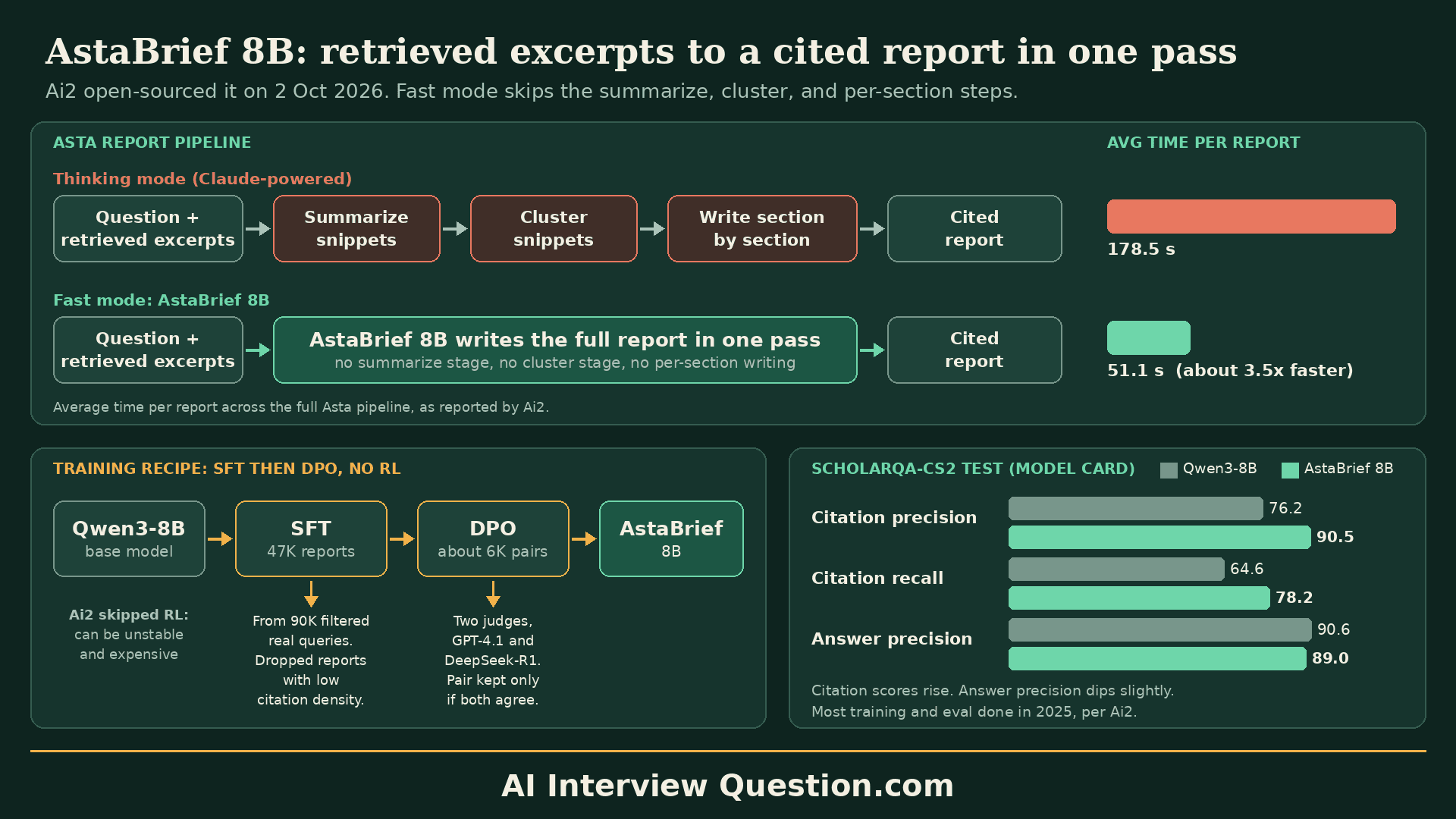
Ai2 open-sourced AstaBrief 8B on 2 October 2026. It takes a research question plus retrieved literature excerpts and writes a cited report in one pass. It already runs in Asta's Generate a report feature as Fast mode, next to the Claude-powered Thinking mode. Ai2 released the weights, the training data, and an example workflow for making reports from your own PDFs.
The speed comes from the pipeline, not only the model. Thinking mode summarizes snippets, clusters them, and writes section by section. AstaBrief skips the summarization and clustering stages and writes the whole report directly from the query and the retrieved snippets. Across the full Asta pipeline, Fast mode averages 51.1 seconds per report against 178.5 seconds for Thinking mode, about 3.5 times faster.
The model starts from Qwen3-8B and uses only supervised fine-tuning followed by DPO. Ai2 considered RL, as used in its DR Tulu work, and chose not to: its post says RL-based training can be unstable and expensive, and the simpler recipe is easier to debug.
Data did the heavy lifting. Ai2 filtered real user queries from ScholarQA, the framework behind Asta's report feature, down to 90K research queries. The multi-step ScholarQA pipeline, backed by Claude 3.5 Sonnet, Claude 3.7 Sonnet, o3, o4-mini, and GPT-4.1, wrote target reports; after quality filtering, 47K usable SFT examples remained. For DPO, a separate query set produced report pairs from the same retrieved excerpts. GPT-4.1 and DeepSeek-R1 judged each pair, and only pairs where both judges agreed were kept, about 6K. Ai2 says those judges showed 95% agreement with human preferences.
Ai2 tested four filters on the synthetic SFT reports: output-to-input token ratio, citation relevance, citation density, and citation diversity. The biggest gain came from one simple rule: drop reports with low citation density. Combining filters, filtering harder, and learning-rate sweeps added nothing meaningful.
On the model card's ScholarQA-CS2 test set, average score goes from 77.3 for base Qwen3-8B to 83.7 after SFT and 87 after DPO. Citation precision climbs from 76.2 to 90.5 and citation recall from 64.6 to 78.2. Answer precision slips from 90.6 to 89. In LLM-judged pairwise comparisons, AstaBrief beats Asta ScholarQA 72% of the time on the test split and 55% on dev, though Ai2 notes that, unlike DR-Tulu, it was optimized for that pairwise ranking during DPO. On the same test split, DR-Tulu-8B scores 88.8 to AstaBrief's 87.0. On DeepScholarBench it scores 53.50, behind Asta ScholarQA at 60.25 and DR-Tulu-8B at 56.26. In a 14-question human study with three researchers, DR-Tulu won overall preference, while two of the three preferred AstaBrief on citation accuracy.
Read the numbers with Ai2's own caveat. Most training and evaluation finished in 2025, and the full evaluation was not rerun against today's frontier models. Ai2 also warns that a citation can be attached and still overstate the source, for example turning a finding about one sample into a claim about a whole population.
Interview angle: use AstaBrief as a case study for the generation half of RAG. Say that a small model trained on filtered, well-cited targets can stand in for a multi-stage summarize-and-cluster chain while staying close on Ai2's quality metrics, and back it with the 51.1 versus 178.5 second figure. Name the metrics separately: coverage, answer precision, citation precision, citation recall. Explain why the team picked SFT plus DPO over RL, and why agreement between two judges cleans preference data. Then show judgment: wins on one benchmark and losses on another mean you evaluate on your own queries, and citation recall does not prove the claim matches the scope of the evidence.
https://allenai.org/blog/astabrief https://huggingface.co/blog/allenai/astabrief https://huggingface.co/allenai/AstaBrief_8B
Deep explanations with architecture diagrams for every question below.
Senior trade-off interview question on Context Precision within RAG.
Read full explanationSenior trade-off interview question on Corrective RAG within RAG.
Read full explanationSenior debugging interview question on Corrective RAG within RAG.
Read full explanationSenior debugging interview question on Faithfulness within RAG.
Read full explanationStaff debugging interview question on Indexing Pipelines within RAG.
Read full explanationMid-Level debugging interview question on Multi-Query Retrieval within RAG.
Read full explanationJunior debugging interview question on PDF Extraction within RAG.
Read full explanationJunior debugging interview question on RAG Architecture within RAG.
Read full explanation