Implement Catastrophic Forgetting correctly in a real-time analytics copilot
Mid-Level implementation interview question on Catastrophic Forgetting within Fine-Tuning.
Read full explanationA composite story of five GenAI mock interviews before a real loop: project deep-dive, system design, evaluation, live coding, and a full back-to-back day.
A quick note first. The candidate in this story is an illustrative composite, not a real person, and nothing here reports a real company's interview or result. The mock format is practical advice you can copy.
Before my first real GenAI interview loop, I had done exactly one mock. A friend asked me a few questions over coffee, nodded, and said I would be fine. I was not fine. The real rounds were longer, the follow-ups went deeper, and I had never practiced being pushed. So for my next loop, I set myself a rule: five realistic mocks before the real thing, each one designed to feel like an actual round.
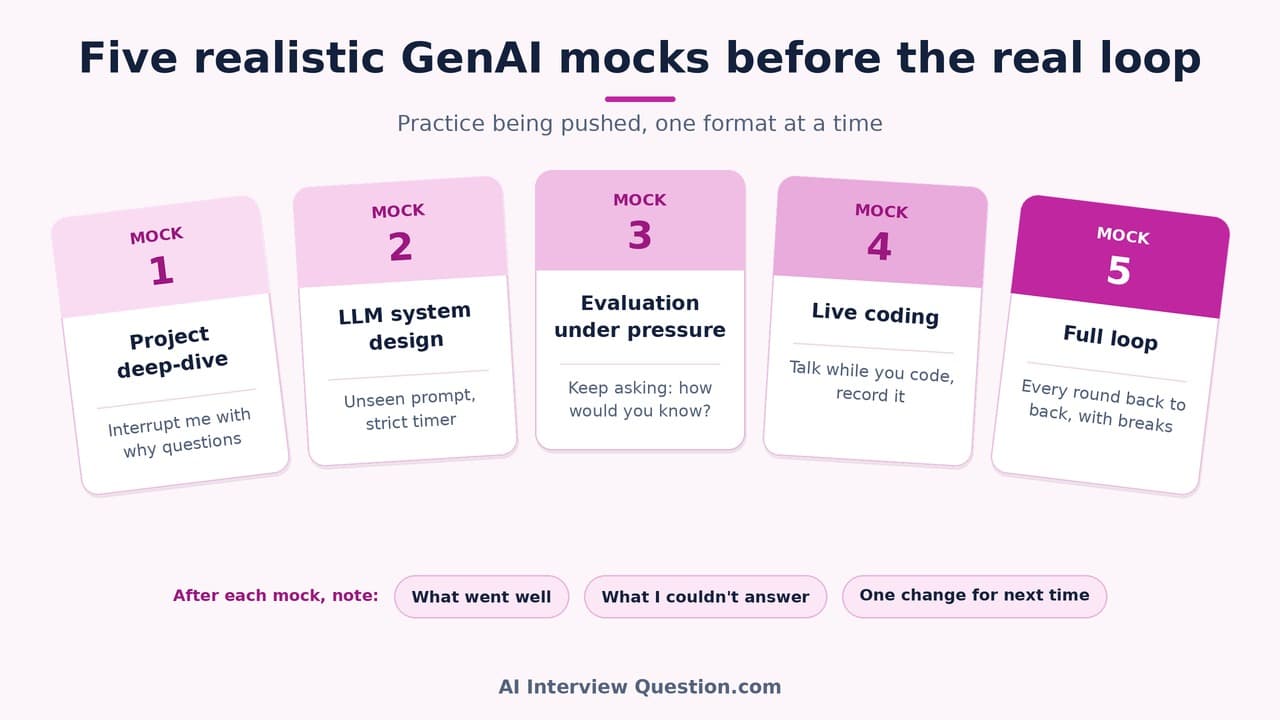
Mock one was the project deep-dive. I asked a friend to read my project README and then interrupt me with why questions for thirty minutes. Why that chunking? Why that model? How did you know it worked? The point was not to look good. It was to find where my explanations ran out. I wrote down every question I could not answer cleanly, and those became my study list. The composite story at /blog/failed-first-rag-deep-dive shows what happens when that prep is skipped.
Mock two was LLM system design. I picked a prompt I had never seen, set a forty-five-minute timer, and talked through it on a whiteboard while someone took notes. I used the same shape every time: requirements, data flow, retrieval, evaluation, failure paths, and cost. Afterwards we compared the notes to what I thought I had said. They were different. The LangGraph agent system design guide at /blog/langgraph-agent-system-design-interview-guide helped me tighten the parts that kept slipping.
Mock three was evaluation under pressure. My partner's only job was to keep asking how I would know. How would you know retrieval is working? How would you know the answer is faithful? How would you know it is ready to ship? This mock fixed my habit of answering with metric names instead of what they catch. The LLM evaluation guide at /blog/llm-evaluation-interview-guide was the reference I used to check my answers afterwards.
Mock four was live coding with a model in the loop. I practiced small, realistic tasks: parsing structured output, writing a retry wrapper, scoring a small test set. I talked while I coded and recorded the session. Listening back showed me how often I went silent when I got stuck, and that is when saying your reasoning out loud matters most.
Mock five was a full loop. I ran the four formats back to back with short breaks, plus a behavioral round, the way the real day would feel. By the fourth hour my answers were noticeably vaguer. That told me to plan food, water, and a short reset between rounds on the real day.
A few things made the mocks realistic. I used people who were willing to push rather than encourage. I never saw the prompt in advance. I kept time strictly. And I wrote a short note after each one: what went well, what I could not answer, and one change for next time. If you do not have a partner, recording yourself answering a fixed list of prompts aloud still works better than reading notes silently.
When the real loop came, it still had questions I could not answer. But none of the formats surprised me, and when I got stuck I knew how to say what I would check next. For a structured plan to pair with these mocks, the roadmap at /blog/30-day-plan-first-genai-interview lays out what to study between them.
Deep explanations with architecture diagrams for every question below.
Mid-Level implementation interview question on Catastrophic Forgetting within Fine-Tuning.
Read full explanationMid-Level implementation interview question on Dataset Preparation within Fine-Tuning.
Read full explanationMid-Level trade-off interview question on Catastrophic Forgetting within Fine-Tuning.
Read full explanationMid-Level architecture interview question on Overfitting within Fine-Tuning.
Read full explanationMid-Level evaluation interview question on Catastrophic Forgetting within Fine-Tuning.
Read full explanationMid-Level evaluation interview question on Dataset Preparation within Fine-Tuning.
Read full explanationSenior conceptual interview question on Chat Templates within Fine-Tuning.
Read full explanationMid-Level conceptual interview question on Learning Rate within Fine-Tuning.
Read full explanation