Debug Evaluation regression in a multi-tenant AI support platform
Senior debugging interview question on Evaluation within Fine-Tuning.
Read full explanationA common grading rubric for GenAI take-home assignments: runs cleanly, clear scope, defensible design, real evaluation, failure handling, and a strong README.
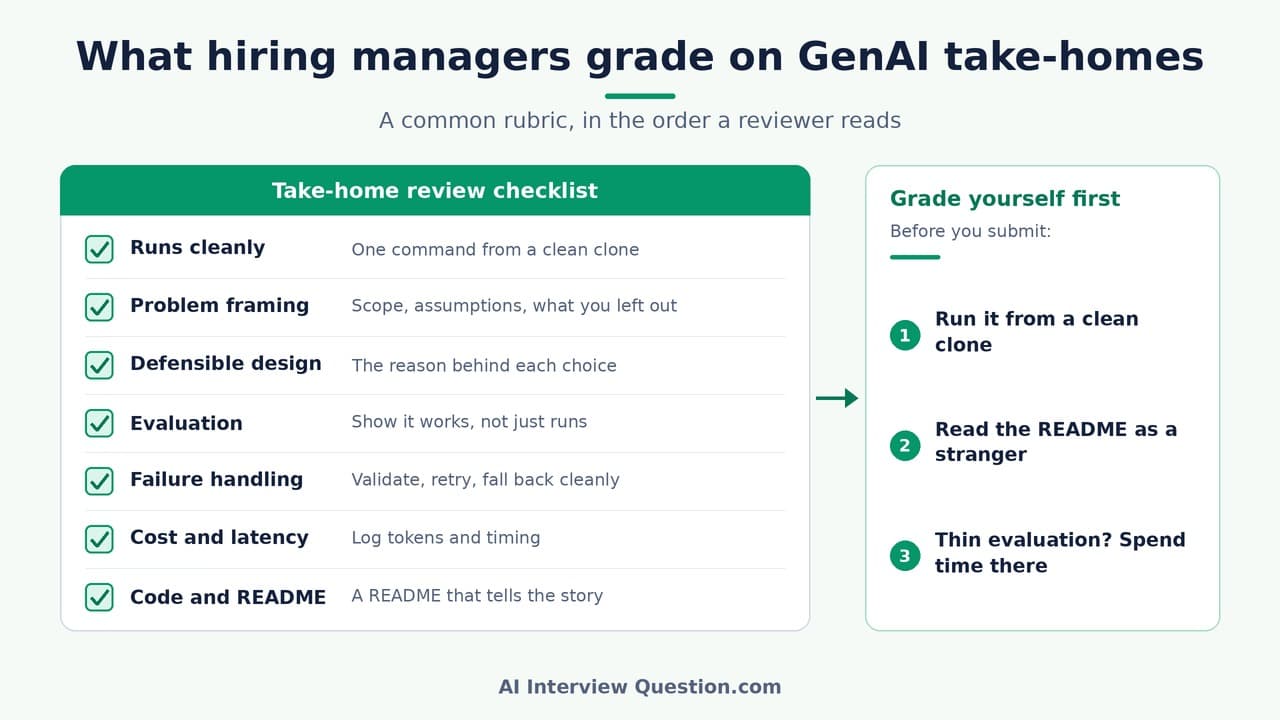
This is a common grading rubric for GenAI take-home assignments, put together as practical guidance. It is not a description of how any named company grades, and it does not report hiring outcomes or statistics. Treat it as a checklist for what a careful reviewer is likely to look for, then use it to review your own submission before you send it.
A typical take-home asks you to build something small with a language model in a few hours or days: a question-answering tool over documents, an extraction pipeline, a small agent, or a classifier. The code is only part of what gets read. A reviewer usually has limited time, so the first few minutes with your submission matter a lot. The rubric below is ordered roughly the way a reviewer might move through it.
The first thing to grade is whether it runs. Can a reviewer clone it, follow the README, and get a result without guessing? Pin dependencies, keep secrets out of the repo, use a sample config, and include one command that runs the whole thing. A submission that does not start is hard to grade on anything else.
The second is problem framing. Did you restate the task, name your assumptions, and say what you chose not to do? A short section on scope and trade-offs shows judgment before the reviewer reads a single line of code. It also protects you, because a missing feature reads very differently when you explained why you left it out.
The third is design choices you can defend. If you used retrieval, why that chunking approach, that embedding model, that number of results? If you added a reranker or query rewriting, what problem did it fix? In this rubric, the reason behind a tool matters more than which tool you picked. The guides on chunking at /blog/chunking-and-overlap-rag-interview-guide, reranking at /blog/when-to-add-reranker-rag-interview, and query rewriting at /blog/query-rewriting-decomposition-rag-interview-guide are good references for the reasoning to write down.
The fourth, and the one worth the most of your time, is evaluation. Did you show that it works, or only that it runs? Include a small test set with expected results, a script that scores the system against it, and a short table of what you measured. For retrieval systems, check retrieval and answer quality separately. For agents, check the final state or action, not just the reply text. Then show a few failures honestly and say what you would try next. The LLM evaluation guide at /blog/llm-evaluation-interview-guide covers how to structure this.
The fifth is failure handling. What happens when retrieval returns nothing useful, the model returns malformed output, or a tool call fails? Validate structured output, retry where it makes sense, set step limits on anything agent-like, and fall back cleanly. If you built an agent, the LangGraph agent design guide at /blog/langgraph-agent-system-design-interview-guide shows how to make state and stopping rules visible.
The sixth is cost and latency awareness. You do not need production benchmarks, but log token usage and timing, and add a short note on what would change at higher traffic, such as caching, smaller models for easy steps, or trimming context.
The seventh is code quality and communication. Clear structure, readable names, prompts kept in their own files rather than buried in code, and a README that tells the story: what you built, how to run it, how you evaluated it, what failed, and what you would do with more time. Assume the README is the first thing a reviewer reads.
A useful last step is to grade yourself with this list before you submit. Run it fresh from a clean clone. Read your README as if you were a stranger with fifteen minutes. If the evaluation section is thin, spend your remaining time there rather than on another feature. For more on the foundations behind most take-homes, the RAG interview guide at /blog/rag-interview-guide is a solid refresher.
Deep explanations with architecture diagrams for every question below.
Senior debugging interview question on Evaluation within Fine-Tuning.
Read full explanationSenior architecture interview question on Evaluation within Fine-Tuning.
Read full explanationStaff evaluation interview question on Access Control within RAG.
Read full explanationJunior evaluation interview question on Activation Functions within Deep Learning.
Read full explanationJunior evaluation interview question on Agent Delegation within Multi-Agent Systems.
Read full explanationSenior evaluation interview question on Agent Observability within AI Agents.
Read full explanationSenior evaluation interview question on Agent Security within AI Agents.
Read full explanationMid-Level evaluation interview question on Agentic RAG within RAG.
Read full explanation