Explain Multimodal RAG with a production scenario
Senior conceptual interview question on Multimodal RAG within RAG.
Read full explanationA seven-day plan for a multimodal RAG interview: ingestion choices, structure-aware chunking, retrieval across content types, grounding, and evaluation.
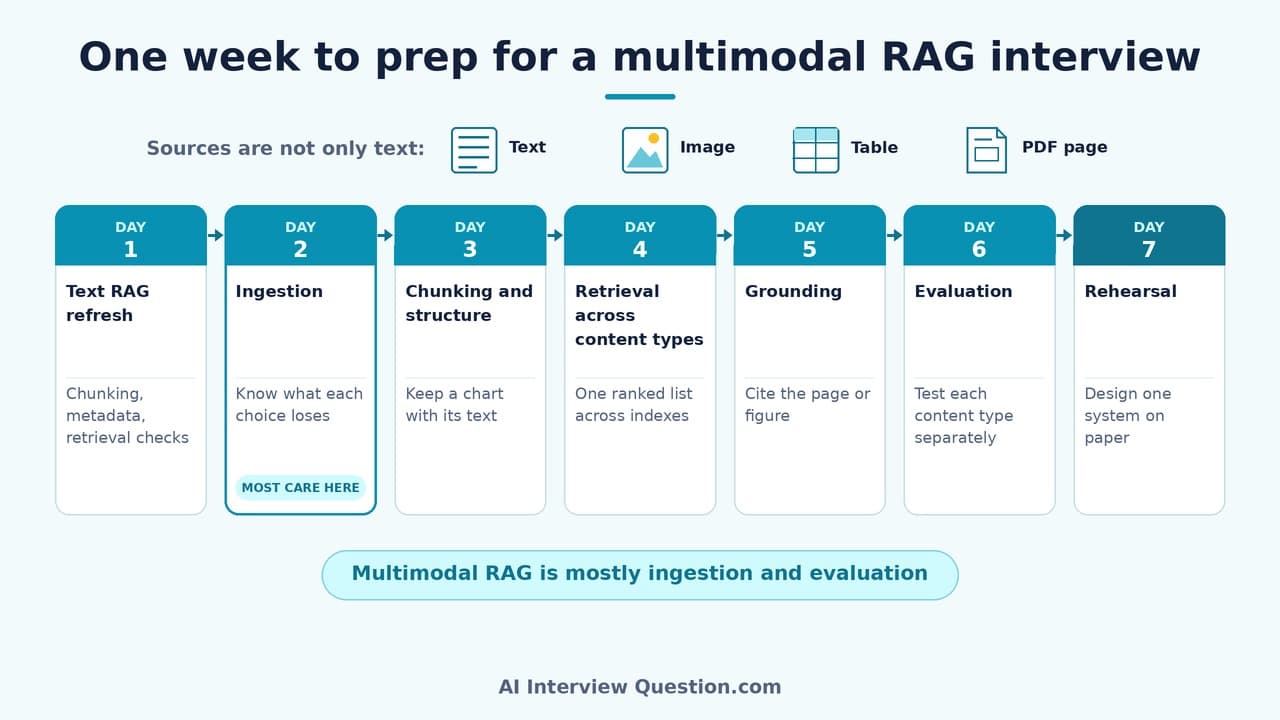
A multimodal RAG interview asks you to reason about retrieval when the source material is not only text. It might be scanned documents, slides, diagrams, screenshots, tables, or images with captions. One focused week is enough to prepare if you already understand text RAG and you spend the week on what changes when the data stops being plain text.
Day 1 is a text RAG refresh. Make sure the basics are solid: chunking, embeddings, metadata, retrieval checks, and grounding the answer in what was retrieved. Multimodal questions build on these, so gaps here show up fast. The RAG interview guide at /blog/rag-interview-guide and the debugging walkthrough at /blog/how-to-debug-a-rag-pipeline-retrieval-ranking-and-grounding are the refresh.
Day 2 is ingestion. Spend the most care here. Practice explaining the choices for each content type. You can extract text from a page and keep layout hints. You can describe an image or chart in text and index that description. Or you can embed the image directly with a model that maps images and text into a shared space. Be ready to say what each choice loses, such as table structure, small text in figures, or the link between a caption and its image.
Day 3 is chunking and structure. A slide, a page, a table, and a figure are natural units, and splitting them blindly can separate a chart from the text that explains it. Practice designing chunks that keep related content together, with metadata such as page number, section, and content type. The chunking guide at /blog/chunking-and-overlap-rag-interview-guide covers the text side of this reasoning.
Day 4 is retrieval across types. Think through how a text question finds an answer that lives in an image, and how you would combine results from different indexes or content types into one ranked list. Be ready to discuss filtering by content type, and when a second ranking stage helps. The reranker guide at /blog/when-to-add-reranker-rag-interview is useful here.
Day 5 is generation and grounding. Practice explaining how the retrieved images or page regions reach the model, how citations point back to a page or figure, and what happens when the model describes something the retrieved content does not show. The guide at /blog/model-ignores-retrieved-context-rag-interview-guide covers grounding failures you can adapt.
Day 6 is evaluation. Build a small test set with questions whose answers live in different content types: a sentence, a table cell, a chart, a diagram label. Check retrieval and answer quality separately for each type, because a system can be strong on text and weak on figures. The LLM evaluation guide at /blog/llm-evaluation-interview-guide covers how to structure it. If you want a recent news angle on the topic, the post at /blog/cloudflare-ai-search-ga-multimodal-interview is on the site.
Day 7 is rehearsal. Design one multimodal system on paper, such as question answering over a product manual with diagrams. Go through ingestion, chunking, retrieval, grounding, evaluation, and cost, and practice saying out loud what you would measure first when an answer is wrong.
The key idea to carry into the room is that multimodal RAG is mostly an ingestion and evaluation problem. If you can explain how each content type gets indexed, what is lost along the way, and how you would catch it, you will have something real to say for most follow-ups.
Deep explanations with architecture diagrams for every question below.
Senior conceptual interview question on Multimodal RAG within RAG.
Read full explanationSenior production incident interview question on Multimodal RAG within RAG.
Read full explanationSenior system design interview question on Multimodal RAG within RAG.
Read full explanationSenior trade-off interview question on Context Precision within RAG.
Read full explanationSenior trade-off interview question on Corrective RAG within RAG.
Read full explanationSenior debugging interview question on Corrective RAG within RAG.
Read full explanationSenior debugging interview question on Faithfulness within RAG.
Read full explanationStaff debugging interview question on Indexing Pipelines within RAG.
Read full explanation