Indexing Pipelines trade-offs for a document intelligence pipeline
Staff trade-off interview question on Indexing Pipelines within RAG.
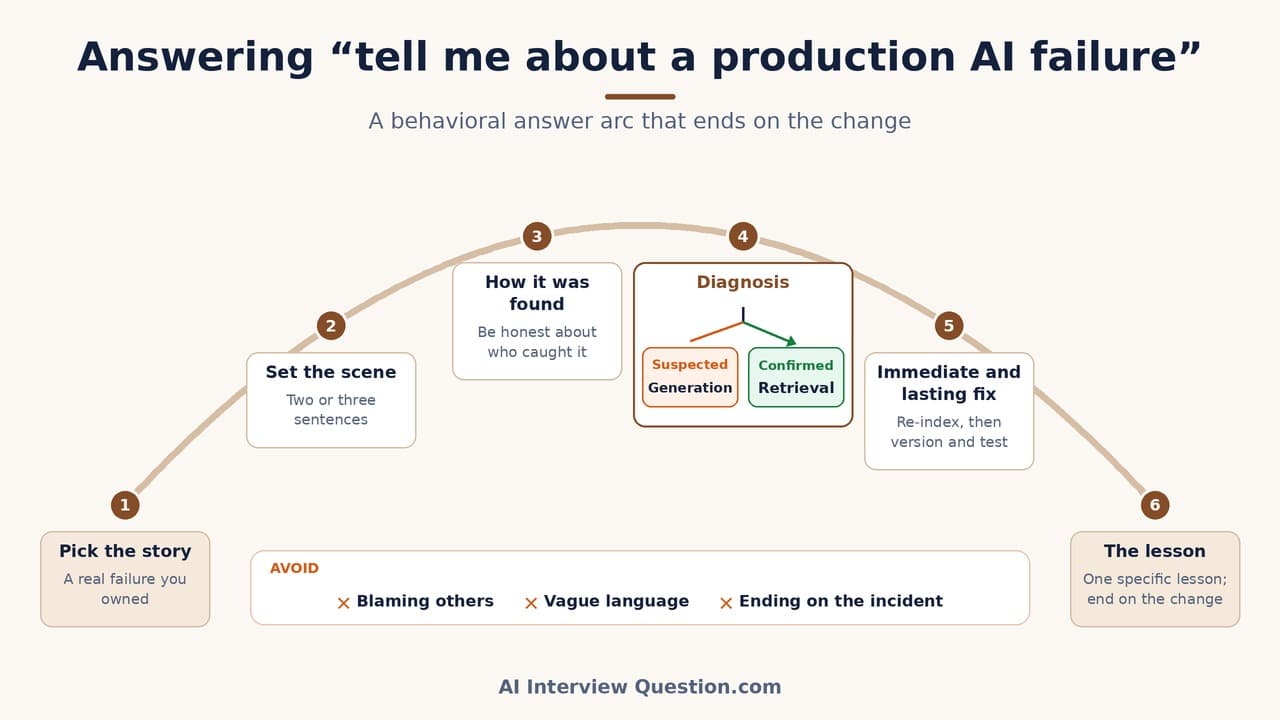
Read full explanationA composite story on answering the production AI failure question: pick the right story, diagnose honestly, show the lasting fix, and end on the change.
A quick note first. The candidate in this story is an illustrative composite, not a real person, and the failure described is a realistic example, not a real company's incident.
A behavioral round for an AI role can include some version of one question: tell me about a time an AI system you worked on failed in production. The first time I got it, I panicked and described a bug that was not really mine and not really about AI. The interviewer moved on politely. I knew I had wasted the question. Here is how I learned to answer it.
Start by picking the right story. A good one has a real failure, a part you personally owned, something you measured, and a change that came out of it. It does not need to be dramatic. My eventual story was a support assistant that started giving confident answers from an outdated policy document after the policy changed. Nobody was hurt, but customers were told the wrong thing, and I was the one who owned the retrieval pipeline.
Set the scene in two or three sentences. What the system did, who used it, and what your role was. Interviewers do not need the whole architecture. They need enough to follow the failure.
Describe how the failure was found, and be honest. In my story, it was found by a support lead who noticed repeated complaints, not by our monitoring. Saying that out loud felt bad, but it set up the most important part of the answer, which was what we changed so we would catch it ourselves next time.
Explain the diagnosis like an engineer. Separate what you suspected from what you confirmed. We first assumed the model was making things up. When we looked at what retrieval actually returned, the old policy document was still in the index and ranked above the new one. The model was faithfully answering from the wrong source. That distinction, retrieval versus generation, is the kind of reasoning interviewers want to hear. The RAG debugging walkthrough at /blog/how-to-debug-a-rag-pipeline-retrieval-ranking-and-grounding covers it in more depth.
Then the fix, in two layers. The immediate fix was removing the stale document and re-indexing. The lasting fix was a process: documents carry a version and an effective date, retrieval filters out superseded versions, and a small set of policy questions runs as a test after every content update. The LLM evaluation guide at /blog/llm-evaluation-interview-guide describes how to frame that kind of check.
Close with what you learned and would do differently. Mine was that we had evaluated the model carefully and the data pipeline barely at all, and that a confident wrong answer is harder to notice than an error message. Keep this part short and specific. One clear lesson beats a list of generic ones.
A few things to avoid. Do not blame a teammate or a vendor. Do not pick a story where you only watched. Do not hide the failure behind vague language like "there were some issues." And do not end on the incident. End on the change.
Practice the story out loud until it fits in about two minutes, then prepare for follow-ups: what would you monitor now, how would you explain it to a non-technical stakeholder, and what would you do if it happened again tomorrow. The behavioral interview guide at /blog/ai-career-behavioral-interview-guide has more on structuring answers like this one.
Deep explanations with architecture diagrams for every question below.
Staff trade-off interview question on Indexing Pipelines within RAG.
Read full explanationStaff scenario interview question on Multi-Tenancy within RAG.
Read full explanationSenior trade-off interview question on Context Precision within RAG.
Read full explanationSenior trade-off interview question on Corrective RAG within RAG.
Read full explanationStaff debugging interview question on Indexing Pipelines within RAG.
Read full explanationStaff architecture interview question on Indexing Pipelines within RAG.
Read full explanationStaff evaluation interview question on Access Control within RAG.
Read full explanationJunior conceptual interview question on Context Injection within RAG.
Read full explanation