Debug Prompt Injection regression in a multi-tenant AI support platform
Junior debugging interview question on Prompt Injection within AI Security.
Read full explanationA two-week plan for AI security interviews: threat modeling, prompt injection, data exposure, tool permissions, governance, testing, and a rehearsal.
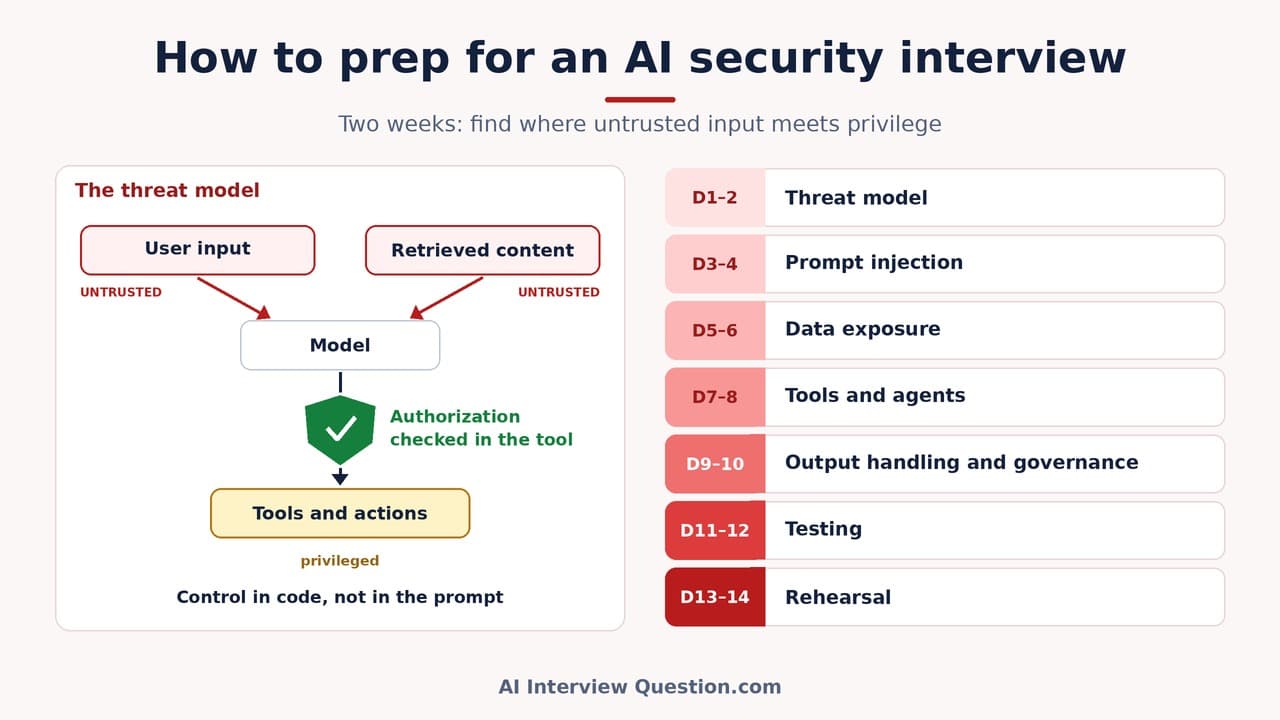
Two weeks is enough to prepare for an AI security interview if you already understand how language-model applications are built. The focus is not memorizing attack names. It is learning to look at a system, find where untrusted input meets a privileged action, and explain how you would contain it. Plan for focused weekday sessions and a longer one each weekend.
Days 1 and 2 are the threat model. Draw a typical application end to end: user input, system prompt, retrieval, tools, model output, and any downstream system that acts on that output. For each arrow, ask what an attacker could control and what they could reach. This picture is the backbone for every later answer.
Days 3 and 4 are prompt injection. Study both direct injection from the user and indirect injection from content the system reads, such as retrieved documents, web pages, emails, or tool results. Practice explaining why a line in the system prompt is not an access control, and why the safer design limits what the model is allowed to do rather than trusting it to refuse.
Days 5 and 6 are data exposure. Think through how sensitive data leaks: through retrieval that is not scoped to the right user or tenant, through logs, or through the model repeating something it was given. The multi-tenant RAG isolation guide at /blog/multi-tenant-rag-isolation covers why access control belongs on the retrieve call, before content reaches the model.
Days 7 and 8 are tools and agents. This is where the stakes rise, because tools turn text into actions. Practice designing tools with authorization checked inside the tool, least-privilege credentials, confirmation for irreversible actions, and step limits. The MCP security guide at /blog/mcp-security-interview-questions and the MCP tools and server failure modes guide at /blog/mcp-tools-servers-failure-modes-interview are the core reading.
Days 9 and 10 are output handling and governance. Treat model output as untrusted input to whatever consumes it, whether that is a database, a browser, or a shell. Then look at the organizational side: who approves an agent's permissions, how actions are logged, and how you would audit them later. The AI agent governance guide at /blog/ai-agent-governance-interview-questions covers this.
Days 11 and 12 are testing and evaluation. Practice describing how you would test a system for these risks: a set of adversarial inputs, cross-tenant retrieval checks, tool-misuse scenarios, and a review of logs. The point to make is that you check what the system actually did, such as which records it returned or changed, not what the model said it did. The LLM evaluation guide at /blog/llm-evaluation-interview-guide helps you frame that.
Days 13 and 14 are rehearsal. Take one system, such as a support agent with refund powers, and walk through it out loud: the threat model, the top three risks, the controls you would add, and how you would test them. Do at least one mock interview where someone pushes back on every control you propose.
The thread through both weeks is simple. Find where untrusted content meets privilege, put the control in code rather than in the prompt, and say how you would prove it works.
Deep explanations with architecture diagrams for every question below.
Junior debugging interview question on Prompt Injection within AI Security.
Read full explanationJunior architecture interview question on Prompt Injection within AI Security.
Read full explanationJunior scenario interview question on Prompt Injection within AI Security.
Read full explanationSenior trade-off interview question on Audit Logging within AI Security.
Read full explanationMid-Level trade-off interview question on Data Leakage within AI Security.
Read full explanationMid-Level debugging interview question on Audit Logging within AI Security.
Read full explanationMid-Level debugging interview question on Tool Abuse within AI Security.
Read full explanationSenior debugging interview question on Training Data Poisoning within AI Security.
Read full explanation