Design Agent Memory architecture for a coding copilot for a large engineering org
Junior architecture interview question on Agent Memory within AI Agents.
Read full explanationA six-week roadmap for backend engineers moving into AI agents: model basics, retrieval, tool loops, orchestration, evaluation, then cost and rehearsal.
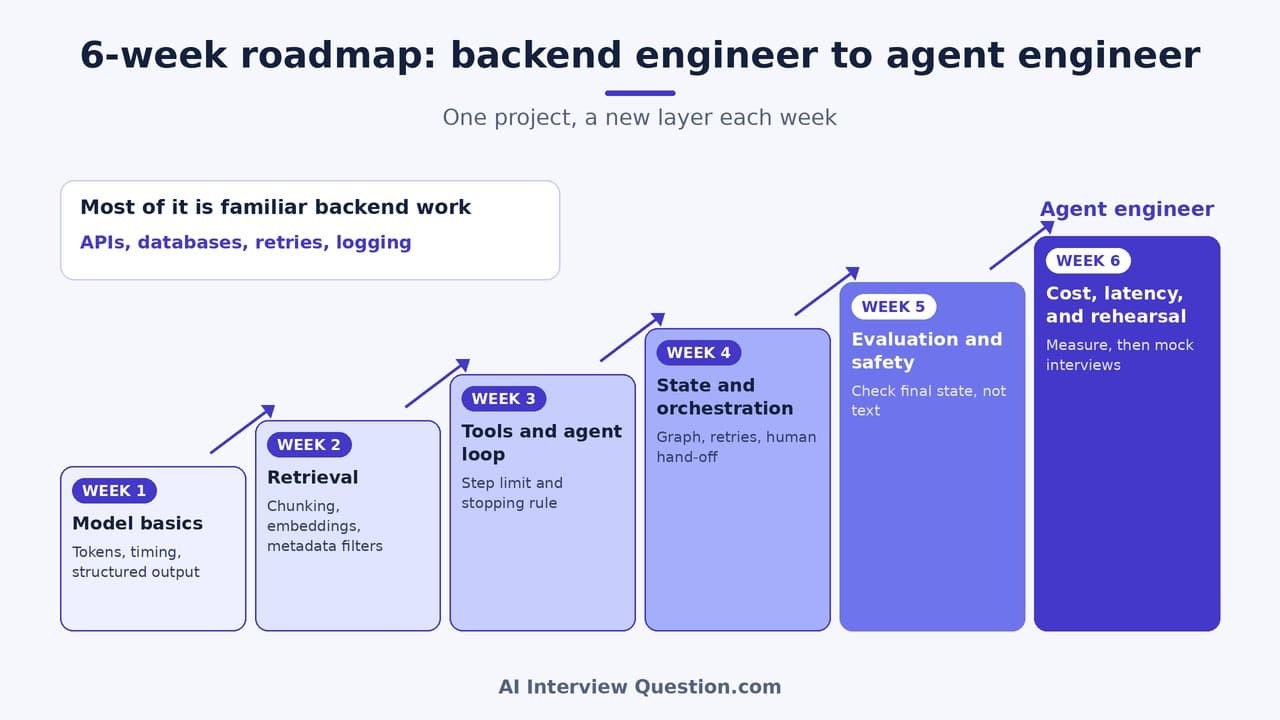
This is a six-week roadmap for a backend engineer who wants to move into building AI agents. It assumes you already ship services, work with APIs and databases, and debug production problems. It does not assume any machine learning background. Plan for a few focused hours on weekdays and a longer build session each weekend, and stretch the weeks if your schedule needs it.
The idea behind the plan is simple. An agent is a service that calls a model, decides what to do next, uses tools, and keeps state. Most of that is familiar backend work. The new parts are working with a component that does not always return the same output, and proving the whole thing behaves well enough to ship. The roadmap builds one project across all six weeks so each week adds a layer you can explain in an interview.
Week 1 is model fundamentals. Learn tokens, context windows, sampling settings, and why outputs vary between runs. Write a small client that calls a model API, logs every request and response, and records token counts and timing. Practice structured output, where the model returns data your code can parse, because agents depend on it. By the end of the week you should be able to explain what a model call costs and why.
Week 2 is retrieval, because most useful agents need to look things up. Build a small search over a set of documents you know well: chunking, embeddings, a vector store, and metadata filters. Check what comes back before you read any generated answer. The RAG interview guide at /blog/rag-interview-guide and the chunking and overlap guide at /blog/chunking-and-overlap-rag-interview-guide cover what to understand here.
Week 3 is tools and the agent loop. Give your project two or three tools, such as search, reading a file, and calling one internal API. Write the loop yourself first: the model picks a tool, your code runs it, the result goes back, and the loop continues until the model answers or a step limit is reached. Doing it by hand once makes every framework easier to reason about. Watch for the common failure of an agent that keeps calling tools without making progress, and fix it with a step limit and a clear stopping rule.
Week 4 is state and orchestration. Move the loop into an explicit graph with named steps, a state object you can print at every step, and branches for success, retry, and hand-off to a human. This is where your backend instincts around idempotency, retries, timeouts, and logging matter most. The LangGraph agent system design guide at /blog/langgraph-agent-system-design-interview-guide shows how to present that design on a whiteboard.
Week 5 is evaluation and safety. Build a fixed set of tasks for your agent with the expected end result for each. Check the final state your agent leaves behind, not only the text it says, because a confident reply can still come with the wrong action. Add checks for tool errors, step counts, and cases where the agent should have asked for help. The LLM evaluation guide at /blog/llm-evaluation-interview-guide covers how to talk about this, and the query rewriting and decomposition guide at /blog/query-rewriting-decomposition-rag-interview-guide helps when your failures trace back to vague or multi-part requests.
Week 6 is cost, latency, and rehearsal. Measure where time and money go across model calls, retrieval, and tools. Try caching, trimming context, and using a smaller model for simple steps, and record what each change did. Then write a five-minute story of your project: the problem, the first version, what broke, how you measured it, and what you changed. Do at least two mock interviews out loud, one on system design and one on debugging a failed agent run.
A few habits make the six weeks count. Keep one project and keep deepening it. Write down every failure, because those become your best interview answers. And when an interviewer asks something you have not built, say what you would check first. For backend engineers, that habit is already second nature, and it is a strong habit to bring into an agent engineering interview.
For a longer, story-style version of this switch, read From backend dev to AI engineer in 90 days at /blog/backend-dev-to-ai-engineer-90-days.
Deep explanations with architecture diagrams for every question below.
Junior architecture interview question on Agent Memory within AI Agents.
Read full explanationStaff architecture interview question on Agent Permissions within AI Agents.
Read full explanationJunior architecture interview question on Agent vs Chatbot within AI Agents.
Read full explanationSenior architecture interview question on Human-in-the-Loop within AI Agents.
Read full explanationMid-Level architecture interview question on Timeout within AI Agents.
Read full explanationMid-Level architecture interview question on Tool Errors within AI Agents.
Read full explanationSenior architecture interview question on Evaluation Strategy within AI Career & Behavioral.
Read full explanationJunior architecture interview question on Production Failure within AI Career & Behavioral.
Read full explanation