AI System Built failure in an enterprise RAG assistant: how would you respond?
Junior scenario interview question on AI System Built within AI Career & Behavioral.
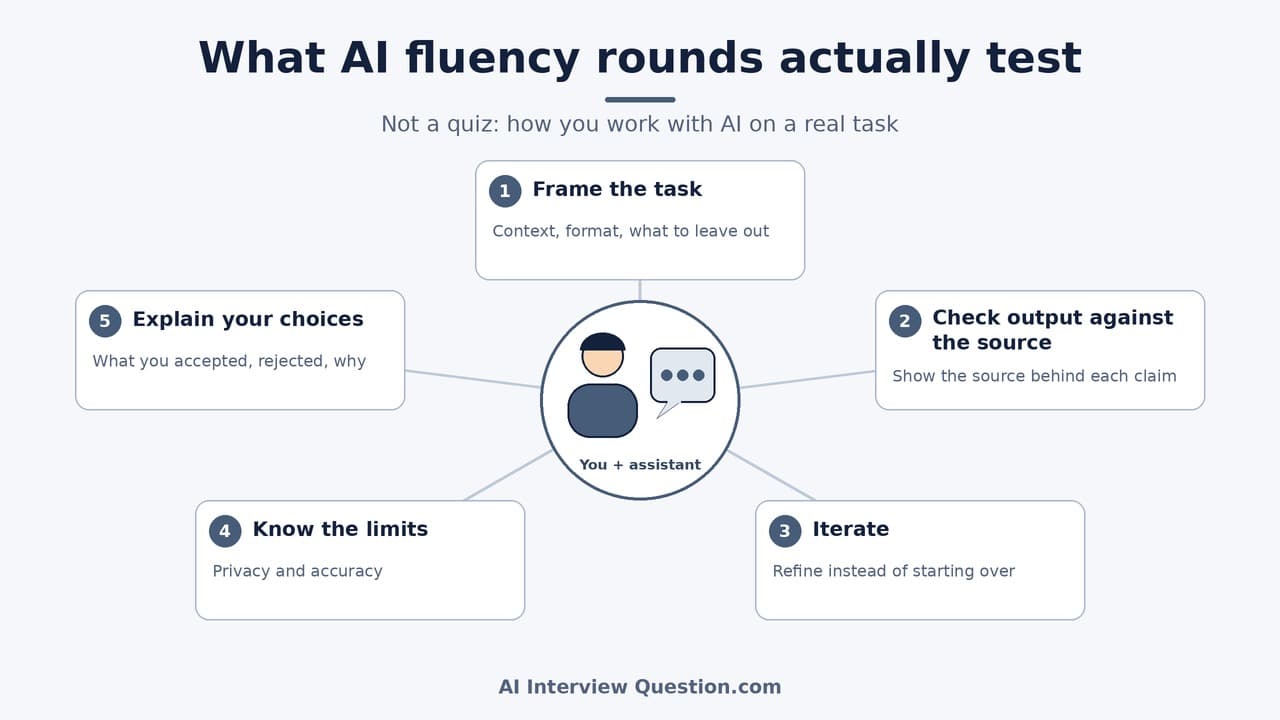
Read full explanationA composite story of an AI fluency interview: not a quiz, but framing tasks, checking output against sources, iterating, knowing limits, and explaining choices.
A quick note first. The candidate in this story is an illustrative composite, not a real person, and the round described here is a common format, not a report of any named company's interview.
The first time I saw an AI fluency round on my schedule, I assumed it would be a quiz. Define a token. Explain temperature. Name the parts of a transformer. I made flashcards. The round turned out to be something else entirely, and the flashcards were mostly useless.
What the round actually tested was whether I could work well with AI tools on a real task and judge their output. The interviewer gave me a small, realistic problem: summarize a messy set of customer feedback into themes and suggest what the team should fix first. I could use an AI assistant however I liked. They watched how I used it.
The first thing it tested was how I framed the task. My first prompt was one line. The output was generic. The interviewer asked what I would change. The better approach was to give the assistant context: who the summary was for, what a useful theme looks like, the format I wanted, and what to leave out. Framing turned out to matter more than any trick wording.
The second thing it tested was whether I checked the output. The assistant produced five confident themes. One of them was not supported by the feedback at all. I only caught it because the interviewer asked me to show which comments supported each theme. What I would do now is check claims against the source as a habit, and say out loud what I am checking. In this round, catching a confident mistake counted for more than a clean first draft.
The third thing it tested was iteration. Instead of starting over when the output was wrong, I learned to refine: ask for evidence, narrow the scope, split the task into steps, or ask the assistant to list what it was unsure about. The interviewer cared about how I improved the result, not whether the first attempt was right.
The fourth thing it tested was judgment about when not to rely on the tool. Partway through, the feedback included a customer's personal details. The right move was to notice that and handle it carefully rather than pasting everything into a tool without thinking. Knowing the limits of a tool, including privacy and accuracy, was part of the score.
The fifth thing it tested was explaining my work. At the end, I had to walk through what I asked, what I accepted, what I rejected, and why. That explanation mattered as much as the final summary.
If you have one of these rounds coming up, practice on real, messy tasks rather than definitions. Pick something like summarizing feedback, drafting a plan, or reviewing a document. Use an assistant, then check every claim against the source, refine at least twice, and explain your choices aloud as if someone were watching. For the technical side of judging model output, the LLM evaluation guide at /blog/llm-evaluation-interview-guide is a good companion, and the mock interview story at /blog/five-realistic-genai-mock-interviews shows how to rehearse a round under realistic pressure.
Deep explanations with architecture diagrams for every question below.
Junior scenario interview question on AI System Built within AI Career & Behavioral.
Read full explanationJunior debugging interview question on AI System Built within AI Career & Behavioral.
Read full explanationSenior debugging interview question on Model Selection within AI Career & Behavioral.
Read full explanationSenior debugging interview question on XML Prompting within Prompt Engineering.
Read full explanationSenior architecture interview question on Evaluation Strategy within AI Career & Behavioral.
Read full explanationJunior architecture interview question on Production Failure within AI Career & Behavioral.
Read full explanationSenior architecture interview question on XML Prompting within Prompt Engineering.
Read full explanationMid-Level evaluation interview question on Cost Reduction within AI Career & Behavioral.
Read full explanation