Deep explanation
Implement Scale Challenges correctly in a real-time analytics copilot
Senior implementation interview question on Scale Challenges within AI Career & Behavioral.
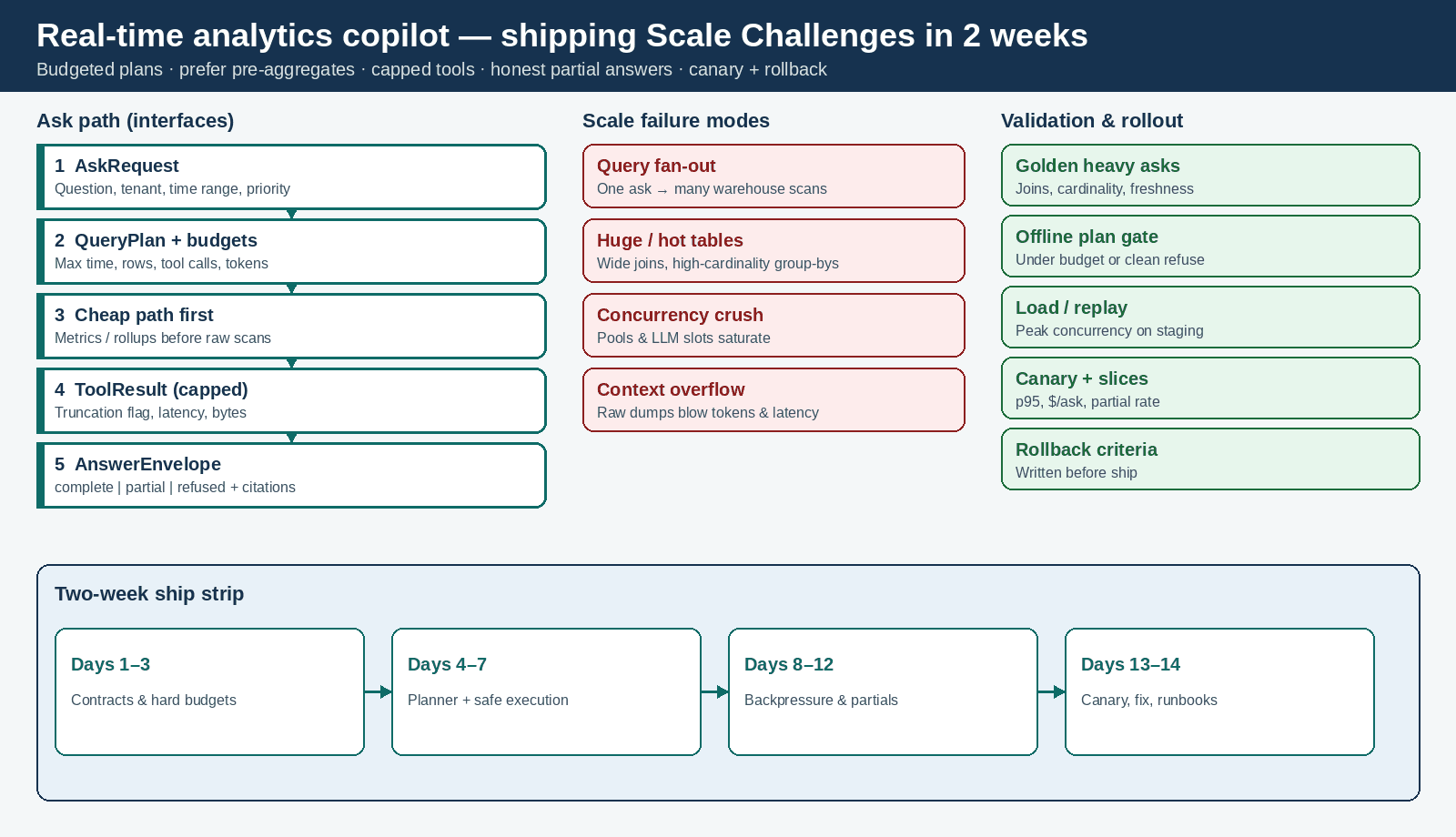
Quick answer
Treat “scale challenges” as concrete failure modes in a real-time analytics copilot: warehouse query fan-out, stale or huge tables, LLM context overflow, and cost/latency spikes under concurrent askers. In two weeks, ship a thin vertical slice—not a rewrite. Week 1: define contracts (Ask → Plan → Tool calls → Verify → Answer), add hard budgets (timeout, max rows, max tool calls, max tokens), and a query planner that prefers pre-aggregates/caches before raw scans. Week 2: add sampling/partial answers, backpressure, and canary eval on a golden set of heavy asks (wide joins, high-cardinality group-bys, streaming freshness). Validate with load replay, slice dashboards (p95 latency, $/ask, empty/partial rate), and explicit rollback if any critical cohort blows the budget.
The interview question
You have two weeks to ship Scale Challenges support in a real-time analytics copilot. What implementation plan, interfaces, and validation steps would you use to avoid production surprises?
Deep explanation
What the question is really asking
Sign in to unlock the full answer
Free accounts include 5 full deep answers. Sign in to start unlocking.
- 25 more sections of deep explanation
- Real-world examples
- Common mistakes
- Interviewer expectations
- Follow-up questions